
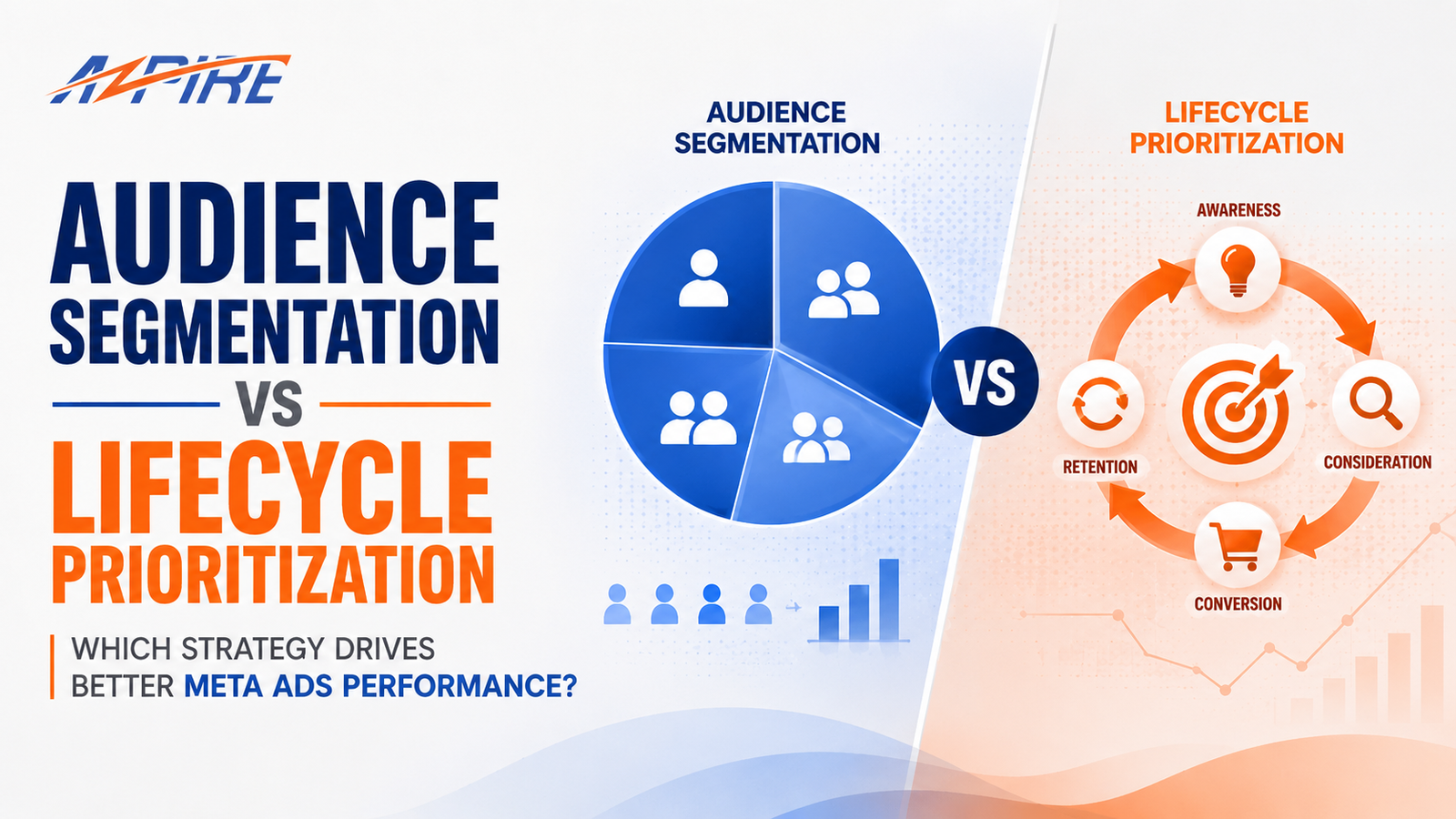
audience segmentation vs lifecycle strategyaudience segmentation vs lifecycle strategyaudience segmentation vs lifecycle strategyaudience segmentation vs lifecycle strategyaudience segmentation vs lifecycle strategyaudience segmentation vs lifecycle strategyaudience segmentation vs lifecycle strategyaudience segmentation vs lifecycle strategyaudience segmentation vs lifecycle strategyaudience segmentation vs lifecycle strategyaudience segmentation vs lifecycle strategyaudience segmentation vs lifecycle strategyaudience segmentation vs lifecycle strategyaudience segmentation vs lifecycle strategyaudience segmentation vs lifecycle strategy
For years, advertisers believed the secret to successful Meta Ads was finding the perfect audience.
Create interest-based audiences.
Build Lookalikes.
Exclude existing customers.
Refine demographics.
Launch campaigns.
That strategy worked well when advertising platforms relied heavily on manual targeting. That’s why the strategy worked well.
But Meta’s advertising ecosystem has changed dramatically.
Today, artificial intelligence analyzes user behavior far more effectively than advertisers can manually build audiences.
Instead of asking,
“Who should I target?”
Modern advertisers should begin asking,
“Where is this customer in their buying journey?”
That single change shifts campaign strategy from traditional audience segmentation toward lifecycle prioritization.
Although both approaches remain valuable, they solve completely different problems.
Advertisers reduce wasted spend while improving customer experience, and make more effective campaign decisions by analyzing these differences.
What Is Audience Segmentation?
Audience segmentation is a segmentation process where people are grouped based on common characteristics.
Those characteristics may include:
- interests
- demographics
- behaviors
- purchase history
- website activity
- location
- customer lists
The goal is straightforward.
Different audiences receive different messages according to their need.
For example, an agency selling Meta Ads services might create campaigns separately for:
- eCommerce businesses
- SaaS companies
- local businesses
- marketing agencies
Each audience receives messaging designed specifically for its industry.
This improves relevance and often produces better engagement.
For many years, this approach represented best practice in digital advertising.
Why Audience Segmentation Still Matters
Audience segmentation is not outdated.
It still plays an important role in campaign planning.
Good segmentation helps businesses :
- improve relevance
- personalize creative
- reduce wasted impressions
- improve engagement quality
It also provides valuable insights into customer characteristics.
However, characteristics alone rarely explain buying intent.
An eCommerce business owner doesn’t automatically purchase your service.
That is where lifecycle strategy becomes much more powerful.
The Biggest Limitation of Audience Segmentation
Audience segmentation answers one important question :
Who is this customer?
Unfortunately, it cannot answer another equally important question :
Where is this customer in the buying journey?
Imagine two people who belong to exactly the same audience.
Both are :
- Marketing Managers
- Interested in Meta Ads
- Located in Singapore
- Working in SaaS companies
Yet one person has never heard of your agency.
The other downloaded your guide last week and has already visited your pricing page three times.
Treating both users identically usually reduces campaign performance.
The audience looks identical.
The buying intent is completely different.
What Is Lifecycle Prioritization?
Lifecycle prioritization organizes campaigns around customer intent rather than customer identity.
The buying intent is completely different.
Marketers focus on those customers who are already engaged in the buying journey rather than their identity.
Most businesses divide the lifecycle into several stages :
- Awareness
- Consideration
- Evaluation
- Conversion
- Retention
- Advocacy
Every stage requires different communication.
Someone discovering your brand for the first time does not need aggressive sales messaging.
Someone comparing solutions needs evidence.
Someone ready to purchase needs confidence.
Existing customers need value beyond the initial sale.
Lifecycle marketing recognizes these differences and adjusts campaign strategy accordingly.
Customer Intent Has Become More Important Than Interests
Meta’s AI has become increasingly effective at understanding behavioral intent.
Rather than relying entirely on manual audience definitions, the platform analyzes signals like:
- engagement quality
- website interactions
- purchase probability
- conversion patterns
- behavioral consistency
Campaigns are now optimized based on intent rather than depending only on interests or demographics.
Many advertisers now combine lifecycle targeting strategy with AI-driven campaign optimization for better results rather than depending solely on manual targeting.
Customer Journeys Are No Longer Linear
A typical buying journey rarely looks like this anymore :
Ad → Click → Purchase
Instead, it often looks like this :
Ad → Video View → Website Visit → Search → Review → Return Visit → Purchase
Sometimes this process takes days.
Sometimes weeks.
Sometimes months.
Each interaction moves the customer closer to a buying decision.
Lifecycle prioritization acknowledges that reality.
Instead of forcing every prospect into the same campaign, businesses guide customers through different stages using different messages.
This creates a much better customer experience.
Audience Segmentation vs Lifecycle Strategy
At first glance, these strategies appear very similar.
Both involve grouping customers.
Both influence targeting.
Both improve relevance.
But their purpose is completely different.
Audience segmentation asks :
Who is this customer?
Lifecycle prioritization asks :
What does this customer need right now?
That difference changes everything.
One approach organizes people.
The other organizes decisions.
Modern Meta campaigns increasingly reward advertisers who understand both.
Segmentation Organizes Audiences
Segmentation helps advertisers understand customer characteristics.
It improves campaign structure.
It supports personalization.
It creates cleaner reporting.
But characteristics alone do not predict buying readiness.
Someone interested in Meta Ads today may still be months away from purchasing.
Lifecycle Strategy Organizes Customer Decisions
Lifecycle marketing focuses on timing.
It identifies the stage where customers currently are and delivers the message most appropriate for that stage.
Instead of showing everyone the same sales message, businesses build trust gradually.
That approach generally produces stronger engagement, higher conversion quality, and better long-term profitability.
Why Meta’s AI Prefers Lifecycle Signals
Moving from audience-based optimization to signal-based optimization is the biggest shift Meta Ads did over the past few years.
Meta continuously analyzes behavior signals to understand which users are most likely to complete the campaign objective rather than depending on interests or demographics.
This is where lifecycle prioritization becomes incredibly valuable.
A person in the awareness stage behaves differently from someone who is already comparing solutions . Signals of an existing customer & new customer who has never interacted with your brand are totally different.
When campaigns are organized around these lifecycle stages, Meta receives clearer optimization signals. The algorithm can make better delivery decisions and improve campaign efficiency over time.
This is one reason why many advertisers are gradually shifting from audience-first strategies toward lifecycle-first campaign planning.
Better Signals Create Better Optimization
Meta’s AI cannot understand your business goals on its own.
It learns through signals.
Every meaningful action helps the algorithm understand user intent.
These signals include :
- video watch time
- landing page engagement
- add-to-cart events
- purchases
- repeat visits
- lead quality
Meta identifies similar high-intent users if these signals become more consistent.
This approach works naturally alongside predictive targeting ads to predict future conversion behavior rather than simply reacting to previous clicks.
Attribution Makes Lifecycle Marketing More Powerful
Many advertisers still judge campaign success rate depending on the final conversion.
Attribution tells a much larger story.
Customers usually discover your brand through an awareness campaign, return later engaging with a remarketing ad, and finally convert after searching for your brand.
Marketers often ignore multiple touchpoints earlier if they only rely on final conversion.
This is why attribution and lifecycle strategy work together.
Lifecycle marketing identifies where the customer is.
Attribution helps explain how the customer reached that stage.
Both together help to analyze the full campaign performance.
This also supports the entire customer lifecycle strategy. In this strategy, every stage contributes to long-term business growth rather than only immediate conversions.
Common Mistakes Advertisers Make
Many advertisers invest significant time to build audience segments but spend very little time to understand customer progression.
Campaigns often become inefficient for this reason.
Most common mistakes include :
- treating new visitors and existing customers the same
- using identical creatives across every stage of the journey
- working only on acquisition ignoring retention
- measuring success using only last-click attribution
- pausing campaigns before Meta completes the learning phase
None of these mistakes are caused by poor targeting.
They happen because the campaign ignores customer intent.
The strongest-performing advertisers build campaigns using how customers move through the buying journey.
Why This Matters More Across APAC Markets
Lifecycle marketing becomes even more valuable across APAC markets, including Bangladesh, Singapore, Malaysia, and Indonesia.
Customers here often research before making purchasing decisions.
Users usually gather knowledge about the product, then compare it multiple times before submitting an inquiry or completing a purchase.
This makes lifecycle-based communication significantly more effective than relying only on audience targeting.
Brands that build trust consistently, and introduce offers at the right moment generally create stronger long-term relationships. As a result, they got stronger than brands that repeatedly push sales messages.
For businesses running Meta Ads across APAC, understanding customer progression is becoming a competitive advantage rather than simply another marketing tactic.
Stable Infrastructure Supports Better Lifecycle Campaigns
Even the best lifecycle strategy depends on reliable campaign infrastructure.
Interrupted delivery, unstable ad accounts, poor event tracking, and inconsistent attribution can all weaken Meta’s learning process.
That is why many advertisers choose partners like Azpire to maintain a stable ad account infrastructure while focusing on campaign strategy and growth.
When campaign stability and lifecycle planning work together, optimization becomes significantly more effective.
Final Thoughts
Audience segmentation is still important because it helps marketers organize customers and personalize communication.
However, modern Meta advertising demands something more.
It requires understanding when customers are ready to receive a particular message.
Lifecycle prioritization fills that gap.
It helps businesses guide customers in the entire buying journey rather than focusing on simply identifying audiences.
When combined with attribution insights, AI-driven optimization, and high-quality creative, lifecycle marketing becomes a long-term growth strategy rather than just another campaign framework.
The businesses that consistently outperform competitors are rarely the ones with the largest budgets.
More often, they are the ones that understand their customers better and deliver the right message at the right moment.
Ready to Build Smarter Lifecycle Campaigns?
Modern Meta Ads are no longer just about reaching more people—they’re about reaching the right people at the right stage.
If you’re looking to improve campaign performance through smarter audience planning, lifecycle marketing, and stable advertising infrastructure, Azpire helps businesses build scalable Meta advertising systems designed for long-term growth.
Whether you’re launching your first campaign or managing multiple ad accounts across global markets, a lifecycle-first strategy can help you make every advertising dollar work harder.
FAQ
What is the difference between audience segmentation and lifecycle prioritization?
Audience segmentation groups people based on shared characteristics such as interests, demographics, or behavior. Lifecycle prioritization focuses on where customers are in their buying journey and delivers messaging that matches their current intent.
Which strategy is better for Meta Ads?
Both strategies work best together. Audience segmentation helps identify potential customers, while lifecycle prioritization improves campaign relevance by matching communication to different stages of the customer journey.
What is a lifecycle targeting strategy?
A lifecycle targeting strategy organizes advertising campaigns around customer stages such as awareness, consideration, conversion, retention, and loyalty instead of relying only on audience characteristics.
How does lifecycle segmentation improve Meta Ads?
Lifecycle segmentation helps advertisers deliver more relevant messaging, improve engagement quality, strengthen optimization signals, and increase long-term customer value.
Why is attribution important for lifecycle marketing?
Attribution helps marketers understand which touchpoints influence customer decisions throughout the buying journey. This allows businesses to invest budget more effectively across different lifecycle stages instead of focusing only on final conversions.