
Lifecycle-Based Budget Allocation: How to Split Budget Between New and Existing Customer
lifecycle-based budget allocationlifecycle-based budget allocationlifecycle-based budget allocationlifecycle-based budget allocationlifecycle-based budget allocation
Every advertising dollar should not be spent the same way. This is one of the biggest mistakes advertisers make.
Most businesses entirely focus on customer acquisition. They launch campaigns & eventually generate leads, and continuously invest more budget for getting new customers.
This appears like a logical growth strategy.
After this new customers drive revenue.
Acquisition alone doesn’t bring growth that sustains.
The businesses that work on scaling consistently understand something which many advertisers overlook:
Acquiring a customer is only the beginning of the customer journey.
This is where lifecycle-based budget allocation becomes important.
Successful marketers ask:
“Where should we invest our budget based on customer intent and lifecycle stage?” instead of asking about the investment amount.
Better outcome, stronger retention, and more profitable growth is achieved by this shift in mindset.
Why Most Advertisers Allocate Budget Incorrectly
Many businesses spend their advertising budget fully for acquiring new customers.
As a result, most of their advertising budget is spent in prospecting campaigns, cold audiences, and top-of-funnel activities.
The problem is that acquiring new customers is usually the most expensive part of the customer journey.
At the same time, existing customers already know about the brand. They have already moved to potential customers by awareness, trust-building, and evaluation stages.
Yet many businesses dedicate only a small percentage of their advertising budget toward retention, re-engagement, or customer loyalty.
This creates an imbalance that often reduces long-term profitability.
The Acquisition Trap
Acquisition campaigns create visible growth.
- More leads.
- More clicks.
- More website visitors.
Businesses naturally prioritize them as these metrics are easy to measure.
However, customer acquisition costs continue rising across most advertising platforms.
- Competition increases.
- Attention becomes harder to capture.
- Consumers become more selective.
Many businesses increase their acquisition budgets rather than improving customer lifecycle management.
This approach becomes both expensive and difficult to sustain with the time.
Why Existing Customers Are Often Ignored
Existing customers are one the most valuable assets of a business.
They have :
- experienced the product
- interacted with the brand
- developed trust
- reduced purchasing friction
In many industries, selling to an existing customer is significantly easier than acquiring a new one.
Despite this, retention campaigns often receive far less attention than acquisition campaigns.
Many brands struggle to maximize customer lifetime value for this.
Understanding Lifecycle-Based Budget Allocation
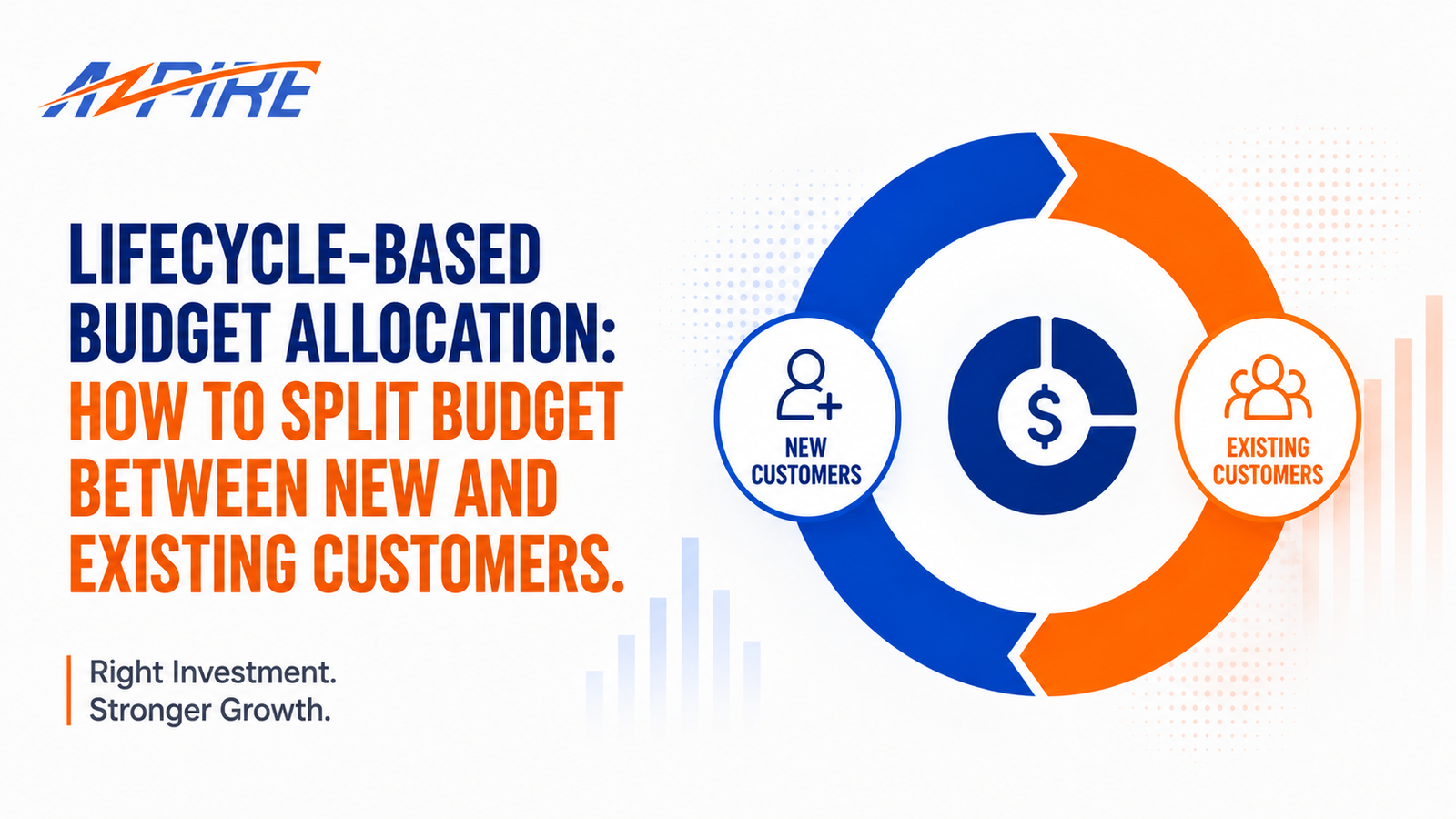
Lifecycle-based budget allocation means spending efficient advertising amounts depending on the customer journey stages. It doesn’t agree with treating every audience the same.
Instead of running a single campaign structure for everyone, advertisers create separate budget allocations for different audience groups.
These groups typically include:
- New customers
- Engaged prospects
- Existing customers
- Repeat buyers
- Brand advocates
Each group has different needs, different intent levels, and different revenue potential.
As a result, each group deserves a different advertising strategy.
Budget Allocation for New Customers
New customer acquisition remains essential.
Without acquisition, businesses cannot grow.
This stage usually focuses on:
- awareness campaigns
- prospecting audiences
- broad targeting
- lookalike audiences
- educational content
This allows new customers to know about the brand.
Because cold audiences require trust-building, acquisition budgets often represent the largest share of total advertising spend.
However, acquisition should not consume the entire budget.
Budget Allocation for Existing Customers
Existing customer campaigns focus on maximizing customer value after the first conversion.
These campaigns often include :
- repeat purchases
- upselling
- cross-selling
- loyalty campaigns
- retention programs
Conversion rates are often higher than customer acquisition as these audiences already trust the brand.
This is why many experienced marketers view retention as a profit multiplier rather than simply a marketing activity.
A Practical Budget Allocation Framework
There is no universal budget allocation formula that works for every business.
The same formula’ll not work for a SaaS company, an eCommerce store, or a service-based agency.
However, successful businesses typically avoid allocating 100% of their budget toward acquisition.
Stable growth and retention is achieved by a healthier lifecycle marketing budget.
Many growing businesses spend the maximum budget of their advertising amount for acquiring new customers. They reserve a minimalistic amount for remarketing & customer retention activities.
The exact percentage varies depending on:
- customer lifetime value
- purchase frequency
- sales cycle length
- business model
- industry competition
The principle remains consistent:
The objective is not simply acquiring customers. The objective is maximizing customer value throughout the entire lifecycle.
Why Audience Segmentation Improves Budget Efficiency
Lifecycle marketing allows to segment the audiences.
Different customers require different messages.
New potential customers require a completely completely different experience than someone who is already an existing customer.
Yet many advertisers still use the same messaging across all audience groups.
This often leads to lower performance.
When campaigns align messaging with customer stage, engagement quality improves and advertising budgets become more efficient.
New Users Need Discovery
New prospects usually require education before conversion.
At this stage, campaigns should focus on:
- problem awareness
- brand introduction
- educational content
- trust-building
Aggressive sales messaging often performs poorly because the relationship has not yet been established.
This is where awareness campaigns create value.
Existing Users Need Relevance
Existing customers already have knowledge and understanding about the brand.
They don’t need the introduction phase.
Instead, they need:
- personalized offers
- product recommendations
- loyalty benefits
- retention-focused communication
When advertisers continue showing acquisition messaging to existing customers, budget efficiency declines.
How Attribution Updates Affect Budget Decisions
Modern advertisers should definitely understand about attribution.
Many businesses still evaluate campaigns using last-click thinking.
However, customer journeys are rarely that simple.
A customer may:
- discover a brand through Meta Ads
- visit a website
- leave without converting
- return through Google Search
- read reviews
- purchase days later
Attribution updates allow a more accurate view of how these interactions contribute to conversions.
Smarter budget decisions are taken by advertisers with the help of this.
Why Last-Click Thinking Is Dangerous
Marketers often undervalue awareness campaigns while focusing entirely on the final conversion event.
As a result, they reduce spending on activities that generate future demand.
This creates short-term optimization but weakens long-term growth.
Attribution data helps reveal the true role of different touchpoints throughout the customer journey.
Better Attribution Creates Better Allocation
The better advertisers understand customer journeys, the better they can allocate budgets.
Attribution insights often reveal:
- which campaigns create awareness
- which campaigns influence consideration
- which campaigns drive final conversions
This allows marketers to invest more intelligently across the lifecycle.
Lifecycle Marketing + AI Optimization
Modern advertising platforms rely heavily on machine learning.
As a result, lifecycle marketing becomes even more powerful when combined with:
These systems help marketers identify:
- high-intent audiences
- future conversion opportunities
- audience quality patterns
- budget allocation opportunities
Advertisers can make more proactive decisions rather than thinking of performance changes.
This creates a stronger growth engine.
Why This Matters More in APAC Markets
Across APAC markets, including Bangladesh, customer trust often develops more slowly than in mature Western markets.
Consumers frequently:
- compare multiple brands
- revisit websites
- engage with several touchpoints
- require multiple interactions before purchasing
This makes lifecycle marketing especially valuable.
Businesses often face difficulties to maximize long-term customer value if they only prioritize acquisition.
Meanwhile, businesses often achieve stronger profitability over time if they invest in customer relationship management.
Stable Infrastructure Supports Better Allocation
Even the best budget strategy struggles when campaign delivery becomes unstable.
This is why many advertisers rely on ecosystems like Azpire and a stable ad account infrastructure to maintain consistent optimization and delivery.
Without stable systems, budget allocation becomes significantly harder to execute effectively.
Final Thoughts
Advertising success is no longer about spending more money.
It is about investing money more intelligently.
Lifecycle-based budget allocation helps advertisers move beyond short-term lead generation and focus on long-term customer value.
By balancing acquisition, retention, and customer experience, businesses create a more sustainable growth model.
Instead of asking:
“How much budget do we need?”
Ask:
“Which stage of the customer journey deserves investment right now?”
That question often leads to better decisions, stronger customer relationships, and more profitable growth.