
Manus AI in Ad CampaignsManus AI in Ad CampaignsManus AI in Ad CampaignsManus AI in Ad CampaignsManus AI in Ad CampaignsManus AI in Ad CampaignsManus AI in Ad CampaignsManus AI in Ad CampaignsManus AI in Ad CampaignsManus AI in Ad CampaignsManus AI in Ad Campaigns
Most ad campaigns don’t fail because of bad creatives.
They fail because of slow or poor decision-making.
You launch a campaign, data starts coming in, and then begins the familiar cycle:
- check performance
- adjust budgets
- tweak audiences
- wait again
By the time you react, the opportunity is often already gone.
This is the fundamental limitation of manual campaign management.
And this is exactly where AI — especially systems like Manus AI — is reshaping how modern ad campaigns operate.
Instead of treating optimization as a series of delayed reactions, AI introduces something far more powerful:
A continuous decision system that evolves with your campaign in real time.
What Is an AI Decision System in Advertising?
Let’s be clear — Manus AI is not just an automation tool.
It doesn’t only “run ads for you.”
It’s here to make decisions inside your campaign.
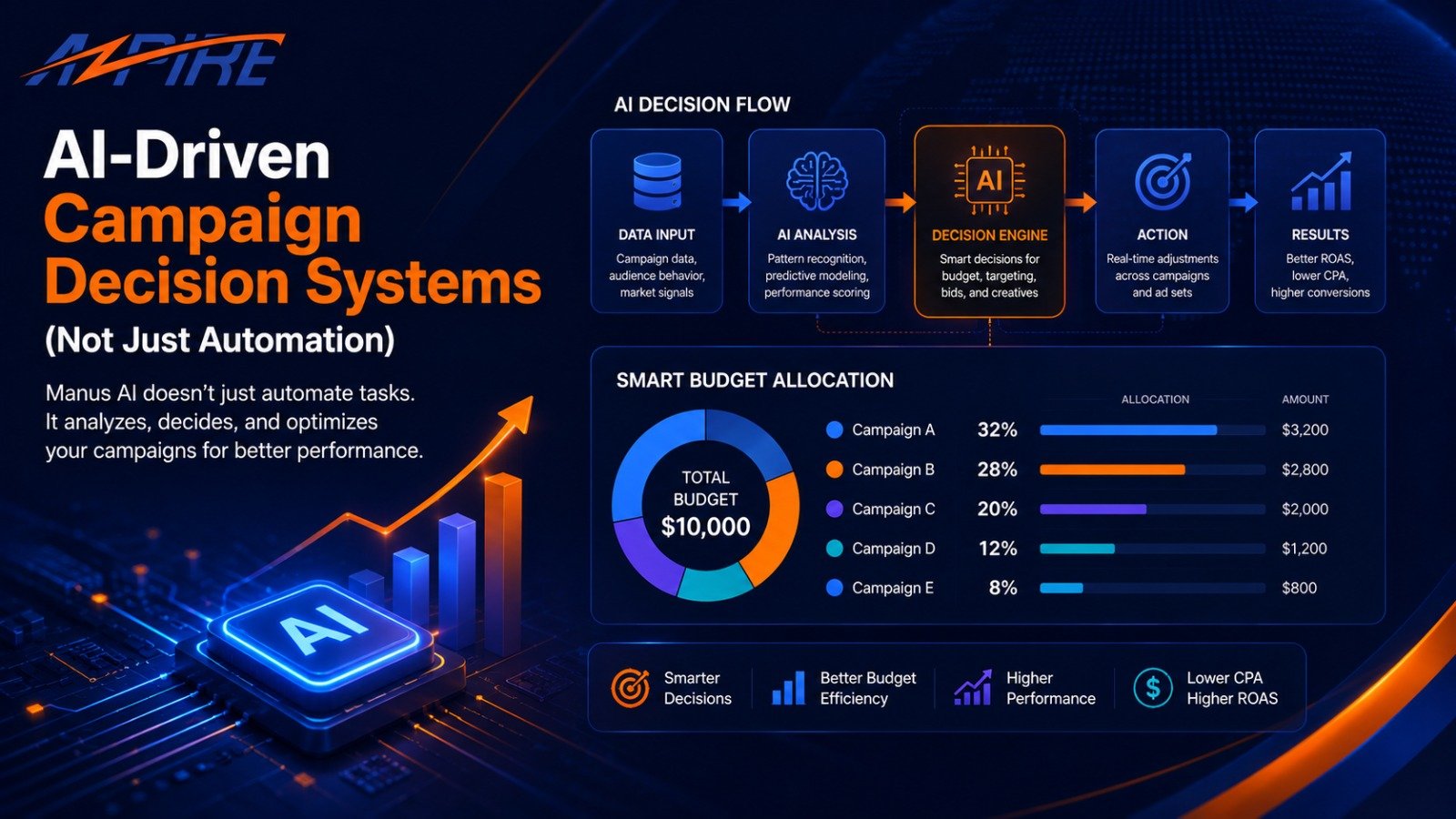
An AI decision system works like this:
Data → Signals → Interpretation → Action
- It collects campaign data such as clicks, impressions, conversions, engagement etc.
- It identifies patterns and behavioral signals
- It interprets which elements are working or failing
- It adjusts campaign variables accordingly
What makes this powerful is not the process itself —
it’s the speed and consistency at which it happens.
A human might take hours or days to notice a trend.
AI detects it almost instantly.
That difference alone can define campaign performance.
How AI Actually Makes Campaign Decisions
To understand the impact of Manus AI, you need to look at where decisions actually matter inside a campaign.
There are three critical areas:
1. Budget Allocation
In manual setups, budget decisions are often based on:
- gut feeling
- limited data
- delayed performance reviews
AI approaches this differently.
It continuously evaluates:
- which ad sets are converting
- which audiences are engaging
- where returns are highest
Then it shifts budget dynamically — sometimes within hours.
This means less wasted spend and faster scaling of winning segments.
2. Audience Refinement
Traditional targeting relies heavily on:
- interests
- demographics
- assumptions
AI goes deeper.
It analyzes behavioral patterns:
- how users interact with ads
- what kind of content they respond to
- how likely they are to convert
Over time, it refines targeting based on real behavior, not assumptions.
This is where campaigns start moving from “targeting people” to “finding buyers.”
3. Bid Optimization
Bidding is one of the most complex parts of advertising.
Manual adjustments often lag behind market conditions.
AI, however:
- reacts to competition instantly
- adjusts bids based on conversion probability
- optimizes for efficiency, not just delivery
The result is a more stable cost structure and better performance consistency.
Why Manual Optimization Breaks at Scale
Manual campaign management works — up to a point.
But once campaigns grow, cracks start to appear.
Delay in Decision-Making
Humans need time to analyze data. AI doesn’t.
Limited Data Processing
Even experienced media buyers can’t process thousands of data points simultaneously.
Human Bias
We often ignore the data and stick with what feels right.
Inconsistent Optimization
Different decisions at different times lead to unstable performance.
Now compare that with AI:
- no delay
- no bias
- consistent logic
- continuous optimization
This is why many advertisers are shifting toward systems like manus ai in ad campaigns instead of relying purely on manual control.
What This Means for Campaign Performance
When AI becomes part of your campaign decision system, a few things start to change:
Faster Optimization Cycles
You don’t wait days to adjust campaigns. Improvements happen continuously.
Better Resource Allocation
Budget flows toward what works — not what you hope will work.
More Stable Scaling
Performance becomes smoother and more predictable rather than sudden fluctuations.
Higher Efficiency
Less wasted spend, better targeting, stronger return on investment.
But this only happens when AI is used correctly — not blindly.
Global vs APAC Reality: Why Context Still Matters
Here’s something most AI discussions ignore:
AI performance depends heavily on the environment it operates in.
In Global Markets
- better tracking infrastructure
- cleaner data
- stable ad account systems
AI thrives in this setup.
In Bangladesh & APAC Markets
The situation is different.
Common challenges include:
- account instability
- payment limitations
- policy restrictions
- inconsistent tracking
These issues disrupt the data flow — and when data is unstable, AI performance drops.
This is why combining AI with a stable ad account infrastructure becomes critical.
Without stability, even the smartest system struggles to perform.
How This Connects to Broader Strategy
AI decision systems don’t exist in isolation.
They work best when connected to:
- predictive targeting strategy
- customer lifecycle planning
- proper attribution systems
AI improves decisions —
but strategy defines what those decisions should optimize for.
When both align, campaigns stop being reactive and start becoming scalable systems.
Where AI Still Falls Short
Let’s keep this real.
AI is powerful — but not perfect.
It Needs Clear Strategy
AI doesn’t define business goals. It optimizes within them.
It Depends on Data Quality
Bad tracking or weak signals lead to poor decisions.
It Can Over-Automate
Too much automation means less control & flexibility.
The best results come from balance:
AI for speed + Human for direction
Practical Takeaways
If you look forward to use AI in your campaigns :
- focus on data quality first
- don’t rely on automation blindly
- monitor performance regularly
- align AI with business goals
- ensure your campaign infrastructure is stable
AI doesn’t replace marketers.
It makes good marketers more effective.
FAQ
What is an AI decision system in advertising?
An AI decision system analyzes campaign performance and optimizes key elements like targeting, budget, bidding automatically using data and machine learning.
Is AI better than manual campaign management?
AI is faster and more consistent than manual campaign management. But the best results arrive from combining AI optimization with human strategy and oversight.
Does AI reduce advertising costs?
AI itself doesn’t directly reduce advertising costs. It improves efficiency that leads to better performance and lower cost per result over time.
Can AI work effectively in markets like Bangladesh?
Depending on the infrastructure, AI works effectively in the Bangladeshi market. Stable ad accounts and proper tracking are essential for AI to perform effectively in APAC regions.
How does AI improve targeting?
AI studies user behavior and engagement patterns to find audiences with higher conversion potential, moving beyond basic demographics.
Final Thought
The future of advertising isn’t about who spends more.
It’s about who makes better decisions, faster.
AI decision systems like Manus AI don’t just optimize campaigns —
they change how campaigns think.
And in a world where attention is short and competition is high,
that shift can be the difference between average results and scalable growth.