
How Manus AI Improves Ad Performance How Manus AI Improves Ad PerformanceHow Manus AI Improves Ad PerformanceHow Manus AI Improves Ad PerformanceHow Manus AI Improves Ad PerformanceHow Manus AI Improves Ad PerformanceHow Manus AI Improves Ad PerformanceHow Manus AI Improves Ad PerformanceHow Manus AI Improves Ad Performance
Most ad campaigns don’t fail because of budget.
They fail because of decisions made too late, or based on incomplete data.
That’s the shift we’re seeing in modern advertising.
Today, platforms are faster, competition is higher, and user behavior changes almost instantly — especially across global markets and Asia-Pacific regions like Bangladesh, Malaysia, Indonesia, Hong Kong, Singapore, Thailand, Viet Nam where mobile-first users dominate and attention spans are short.
In this environment, traditional campaign management struggles to keep up.
This is where Manus AI comes in.
Manus AI isn’t just another tool. It helps you to move from reactive optimization to predictive performance which changes everything, mostly it acts as a decision layer inside your campaign.
The Shift: From Manual Control to Intelligent Decision Systems
Not long ago, managing ads meant:
- manually adjusting budgets
- testing audiences one by one
- reacting after performance dropped
That approach still exists — but it’s no longer enough.
Modern campaigns generate massive amounts of data:
- clicks
- impressions
- engagement signals
- conversion patterns
The problem isn’t lack of data.
The problem is how quickly and accurately decisions are made from that data.
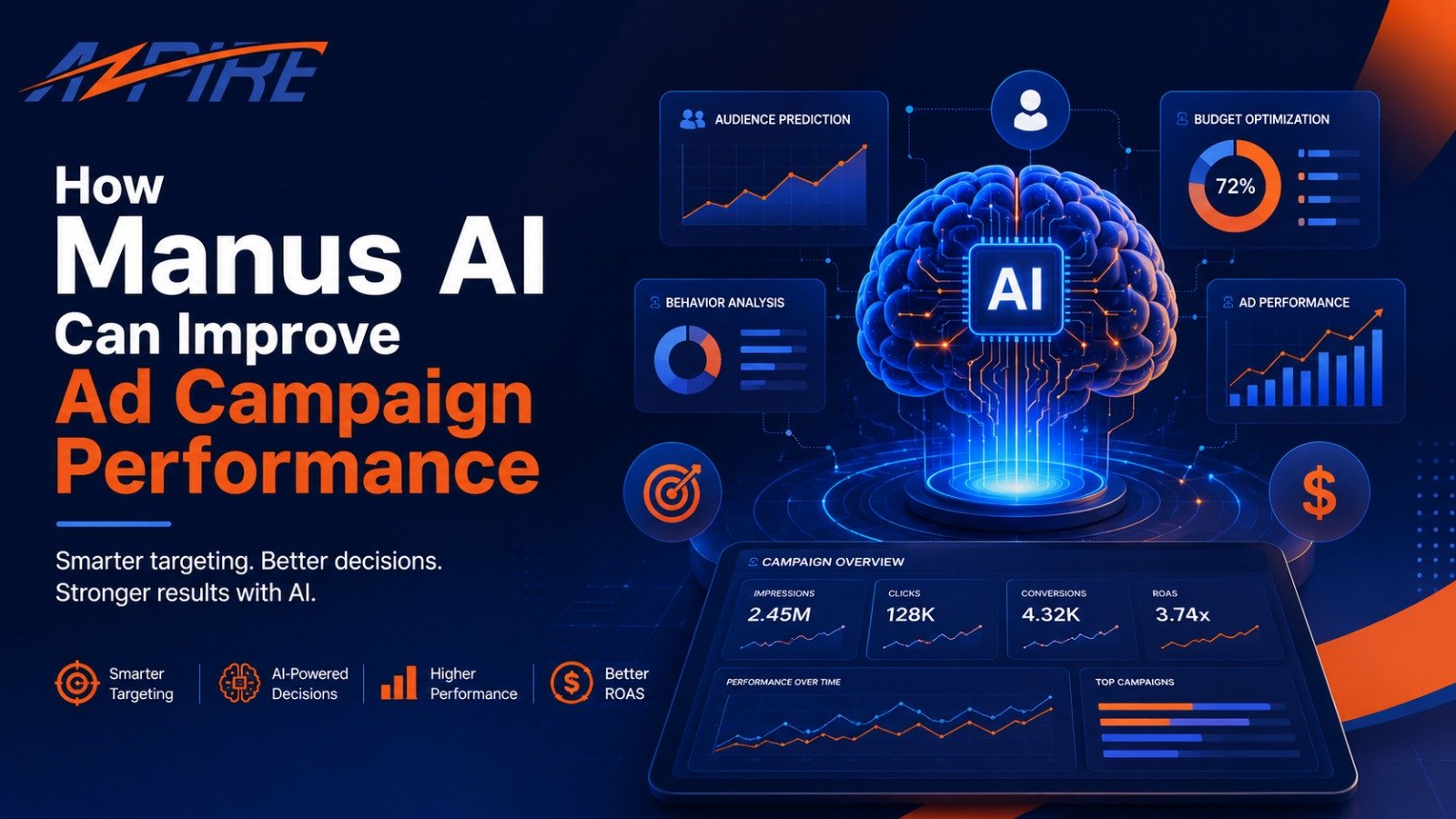
Manus AI steps in as a system that:
- processes large data sets instantly
- identifies patterns humans often miss
- recommends or executes optimization decisions in real time
Instead of waiting days to adjust a campaign, decisions happen continuously.
And over time, that speed compounds into better performance.
AI-Driven Campaign Decisions (Where the Real Impact Happens)
The biggest impact of Manus AI is not automation — it’s decision quality.
Inside a campaign, three core areas define performance:
1. Budget Allocation
AI can identify which ad sets or audiences are performing best and shift budget dynamically — without waiting for manual review.
2. Audience Selection
Instead of targeting based only on interests or demographics, AI refines targeting accuracy continuously using user behavior signals.
3. Bid Optimization
AI adjusts bidding strategies in real time based on competition and conversion probability.
What’s important here is not just speed — it’s pattern recognition.
A human might notice trends after a few days.
AI identifies them within hours.
Predictive Targeting vs Reactive Optimization
This is where the real difference becomes clear.
Most advertisers still operate in a reactive model:
- campaign runs
- data comes in
- adjustments are made
But by the time adjustments happen, the opportunity is often already lost.
Manus AI enables a predictive model:
- It analyzes past behavior
- identifies patterns
- anticipates future actions
Instead of asking: “What worked yesterday?”
It asks: “What is most likely to work next?”
This shift is especially important in fast-moving markets like:
- eCommerce
- lead generation
- seasonal campaigns
And even more critical in Asia-Pacific regions, where user behavior is:
- mobile-first
- highly impulsive
- rapidly changing
Predictive targeting allows campaigns to stay ahead — not just keep up.
The Creative + AI Feedback Loop
One of the mostly ignored aspects of AI in advertising is how it engages with creative performance.
Every ad generates signals:
- click-through rate
- watch time
- engagement
- conversion rate
Manus AI continuously learns from these signals.
Here’s how the loop works:
Creative → Performance Data → AI Analysis → Optimization → Better Creative Performance
Over time:
- Weaker creatives are filtered out faster
- High-performing creatives scale quicker
- Campaigns become more efficient without constant manual testing
This is why some campaigns scale smoothly — while others burn budget.
It’s not just the creative.
It’s how quickly the system learns from it.
Global vs Bangladesh & APAC: Why Context Matters
AI doesn’t operate in a vacuum.
Its effectiveness depends heavily on the environment.
In Global Markets:
- The data is more structured
- Tracking systems are stronger
- Attribution is more stable
This allows AI to perform at a very high level.
In Bangladesh & APAC Markets:
Things are different.
Common challenges include:
- ad account instability
- payment limitations
- policy restrictions
- inconsistent tracking
These factors can disrupt campaign performance — even when targeting and creatives are strong.
That’s why AI alone is not enough in these regions.
It works best when combined with a stable system —
something like an agency ad account system that ensures:
- consistent account performance
- smoother transactions
- reduced risk of disruption
When infrastructure is stable, AI can actually do its job properly.
Where AI Still Falls Short (And Why It Matters)
It’s easy to overhype AI — but that’s not the full picture.
There are real limitations:
1. AI Still Needs Strategy
AI optimizes within a framework — it doesn’t define business goals.
If your campaign direction is wrong, AI will optimize the wrong thing.
2. Bad Data = Bad Decisions
AI depends on data quality.
If tracking is broken or signals are weak, performance suffers.
3. Over-Automation Risk
Relying completely on automation can remove control.
Human oversight is still necessary — especially for:
- budget control
- creative direction
- strategic decisions
The best results always come from AI + human intelligence working together.
What Actually Improves with Manus AI?
At the end of the day, performance is what matters.
When implemented properly, Manus AI impacts:
- Lower cost per acquisition (CPA)
- Higher return on ad spend (ROAS)
- Faster campaign scaling
- Better audience precision
But these results don’t happen instantly.
They build over time — as the system learns, adapts, and improves.
Where This Fits in a Full Ad Strategy
Manus AI is not a standalone solution.
It’s part of a larger system.
To get the best results, it needs to work alongside:
- a clear customer lifecycle strategy in advertising
- proper attribution tracking
- structured audience segmentation
AI improves decisions —
But strategy defines direction.
When both align, performance becomes predictable.
Practical Takeaways
If you’re thinking about using AI in your campaigns, keep it simple:
- Don’t replace strategy with automation
- Focus on data quality first
- Use AI to enhance decisions — not blindly follow it
- Ensure your account infrastructure is stable
- Monitor performance, even with automation
AI is powerful — but only when used intentionally.
FAQ
What is Manus AI in advertising?
Manus AI refers to intelligent systems used in ad campaigns to analyze data, predict outcomes, and automatically optimize performance. It helps improve decision-making rather than just executing tasks.
Is AI better than manual campaign management?
AI is faster and more scalable, but not necessarily better on its own. The best results come from combining AI efficiency with human strategy.
Can small businesses benefit from AI advertising?
Yes. AI helps small businesses compete by improving targeting, reducing wasted budget, and optimizing performance without requiring large teams.
Does AI reduce ad costs?
Not directly. Instead, it improves efficiency, which leads to better results for the same budget, effectively lowering cost per result over time.
Is AI effective in markets like Bangladesh?
Yes, but it depends on infrastructure. In regions like Bangladesh or APAC, combining AI with a stable ad account system significantly improves performance.
Final Thought
AI is not the future of advertising.
It’s already part of the present.
The real question isn’t whether to use it —
but how well you integrate it into your system.
Because in today’s market,
the difference between average and high-performing campaigns
is no longer budget.
It’s decision quality at scale.