Predictive Targeting vs Reactive Optimization: Why Meta Ads Need Smarter Audience Decisions
Running Meta Ads today is not the same as it was even two or three years ago.
Earlier, advertisers could launch a campaign, test a few interests, monitor performance manually, and still get decent results. But now, campaign environments move much faster. Audience behavior changes quickly, competition is higher, CPMs fluctuates constantly, and attention spans are shorter than ever.
That’s why many advertisers are starting to shift from reactive optimization toward predictive targeting ads strategies powered by behavioral data and AI systems.
Instead of waiting for campaigns to fail and then fixing them afterward,predictive systems focus on identifying signals earlier — before performance starts dropping.
And honestly, this shift is becoming necessary.
Especially for advertisers managing large-scale campaigns or businesses trying to scale consistently across global and APAC markets.
What Most Advertisers Still Do: Reactive Optimization
Many Meta advertisers still optimize campaigns reactively.
The process usually looks like this:
- launch campaign
- wait for data
- monitor CTR, CPC, CPM, CPA
- pause weak ad sets
- increase budget on winners
- repeat again
There’s nothing technically wrong with this approach. In fact, almost everyone starts this way.
The real problem is timing.
By the time advertisers react:
- budget has already been spent
- weak audiences have consumed delivery
- conversion signals are delayed
- creative fatigue may already be happening
This becomes even more difficult when campaigns scale.
A media buyer managing five small campaigns manually is one thing. Managing dozens of ad sets across multiple funnels and markets is completely different.
That’s where predictive systems begin to outperform manual optimization.
What Predictive Targeting Actually Means
Predictive targeting ads are not about “guessing.”
It’s about using behavioral signals and campaign data to identify which audiences are more likely to take action before the advertiser manually reacts.
Instead of relying only on:
- interests
- demographics
- assumptions
Predictive systems analyze:
- engagement patterns
- conversion behavior
- click quality
- watch time
- purchase intent signals
- historical actions
This is why many advertisers are now integrating manus ai in ad campaigns as part of a broader optimization framework.
The goal is no longer just reaching people.
The goal is identifying:
- who is most likely to convert before performance drops.
- That difference changes how campaigns scale.
Why Predictive Targeting Is Becoming More Important in Meta Ads
Meta’s advertising system has become heavily signal-driven.
The platform now relies on:
- machine learning
- behavioral prediction
- engagement patterns
- conversion probability
This means advertisers who still optimize campaigns only through delayed manual actions are often operating slower than the system itself. Predictive targeting helps bridge that gap.
Instead of reacting after poor performance appears, advertisers can make decisions earlier using:
- audience behavior trends
- engagement quality
- creative interaction signals
This is one of the reasons why AI-driven campaign optimization is becoming more important in modern media buying. The campaigns that scale efficiently today are usually not the ones with the biggest budgets. They’re the ones making better decisions faster.
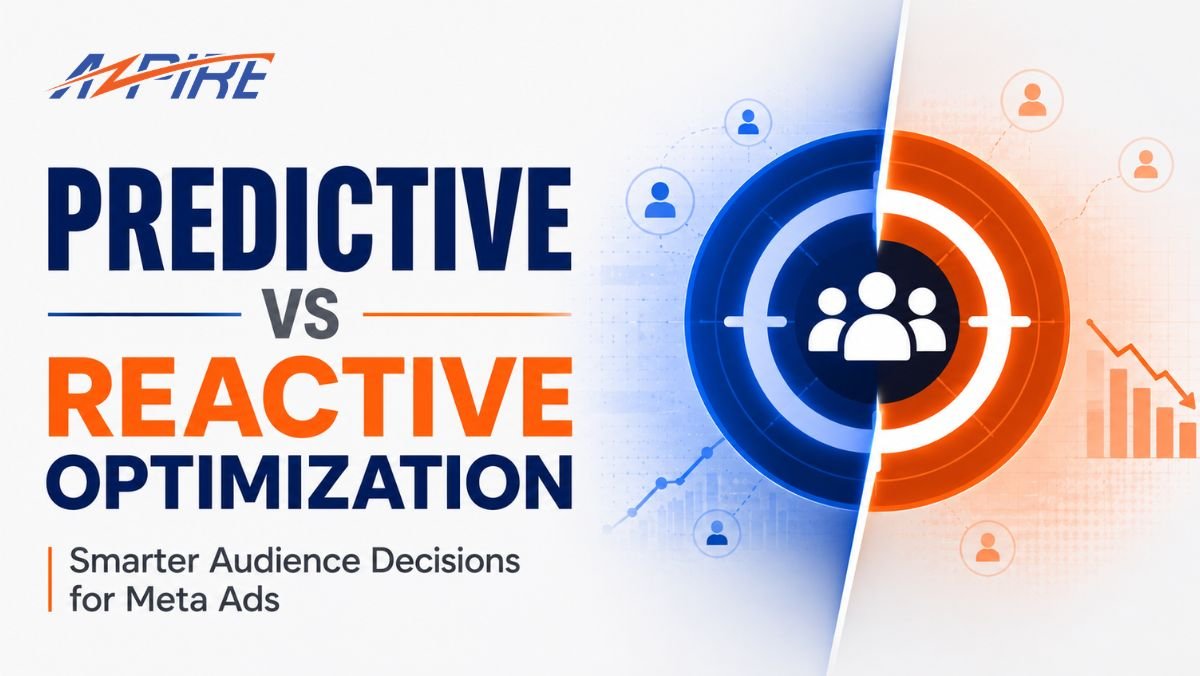
Predictive Targeting vs Reactive Optimization
The difference becomes much clearer when you look at it this way:
| Reactive Optimization | Predictive Targeting |
| Responds after data changes | Uses signals before results fully appear |
| Depends heavily on manual monitoring | Uses AI-assisted pattern recognition |
| Focuses on past performance | Focuses on future conversion probability |
| Slower decision cycles | Faster optimization cycles |
| Often wastes early budget | Helps reduce inefficient spend |
Reactive optimization is still useful.
But it has limitations when campaigns become:
- larger
- faster
- more competitive
Predictive systems help advertisers move from:
“What already happened?”
to:
“What is most likely about to happen?”
That shift is where performance improvements usually begin. This is why predictive targeting ads are becoming more effective than traditional reactive optimization models in many Meta advertising environments.
How AI Audience Prediction Improves Predictive Targeting Ads
One of the biggest advantages of predictive targeting is how it improves audience understanding.
Traditional audience targeting often depends on broad assumptions:
- age
- gender
- interests
- lookalikes
But audience behavior is much more dynamic than that. Two users with the same interests can behave completely differently inside a campaign.
Predictive systems analyze:
This process is heavily connected to AI audience prediction, where campaign systems continuously analyze user intent, engagement behavior, and conversion probability signals.
- interaction depth
- engagement speed
- browsing behavior
- conversion probability
- purchase patterns
Over time, campaigns become better at identifying users who are more likely to:
- click
- engage
- purchase
- submit leads
This is why many scaling advertisers are investing more into predictive targeting strategy rather than relying only on manual audience testing.
Because eventually, audience quality matters more than audience size.
Why This Matters More in APAC Markets
This conversation becomes even more important in APAC regions like Bangladesh.
Unlike some global markets where infrastructure is more stable, many advertisers in this region deal with:
- unstable ad accounts
- payment limitations
- weak tracking setups
- inconsistent campaign learning
- delivery interruptions
And predictive systems depend heavily on stable data flow. Without clean signals, AI performance becomes weaker.
This is why many advertisers across APAC now combine predictive targeting systems with reliable operational ecosystems like Azpire to maintain smoother campaign delivery and stronger account consistency.
Because even the smartest AI system struggles when campaign infrastructure becomes unstable.
Predictive Systems Still Need Human Strategy
This is where many people misunderstand AI.
Predictive targeting does not replace marketers.
It improves decision speed.
But strategy still matters.
AI can optimize:
- delivery
- budget allocation
- audience prediction
But it cannot fully understand:
- market emotion
- offer positioning
- customer psychology
- business direction
That’s why the best-performing campaigns still combine:
- machine intelligence
- human strategic thinking
The gap becomes very obvious when comparing manual vs AI campaign optimization in real-world scaling environments.
The winning approach is usually not “AI only.”
It’s AI + experienced decision-making.
Predictive Targeting Works Best with Lifecycle Thinking
Another mistake advertisers make is focusing only on acquisition. Not every user is at the same stage.
Some users:
- are discovering the brand
- are comparing options
- already engaged previously
- are ready to purchase
This is why predictive systems become much stronger when connected with a proper customer lifecycle strategy in advertising.
Because prediction becomes more accurate when campaigns understand:
- user stage
- intent level
- engagement history
Without lifecycle context, targeting becomes shallow.
With lifecycle thinking, campaigns become much smarter.
Where Predictive Targeting Can Still Fail
Predictive systems are powerful — but not perfect.
There are several situations where they break down.
Weak Tracking Setup
If Pixel or CAPI setup is poor, prediction quality drops immediately. Bad data leads to weak optimization.
Poor Creative Quality
AI cannot fix boring creatives. If the message is weak, targeting alone will not save the campaign.
Unstable Infrastructure
Inconsistent delivery, account restrictions, and platform interruptions affect campaign learning heavily. This is why having a stable ad account infrastructure matters more than most advertisers realize.
Overdependence on Automation
- Blindly trusting automation without strategic oversight creates problems.
- AI helps optimize.
- Humans still define direction.
Practical Takeaways for Meta Advertisers
If you’re running Meta Ads today, predictive targeting should not feel like some “future trend.” It’s already shaping how campaigns perform.
A few practical things matter most:
- focus on clean tracking first
- improve signal quality
- monitor audience behavior early
- separate creative problems from audience problems
- combine AI insights with human strategy
- maintain stable campaign infrastructure
Most importantly: don’t wait too long before making decisions.
Because modern campaigns move faster than manual optimization cycles.
Final Thoughts
Meta advertising goes beyond simple interest targeting and budget increases.
Modern campaign performance depends on:
- signal quality
- prediction accuracy
- optimization speed
- strategic decision-making
Predictive targeting helps advertisers move ahead of performance changes instead of reacting after damage already happens.And in increasingly competitive markets, that difference matters more every year. The advertisers who scale consistently over the next few years probably won’t be the ones spending the most. They’ll be the ones making smarter decisions faster. As Meta’s ecosystem becomes increasingly AI-driven, businesses using predictive targeting ads and stronger AI audience prediction systems will likely gain a significant competitive advantage.
FAQ
What are predictive targeting ads in Meta Ads?
Predictive targeting in Meta Ads means using AI & behavioural data to identify which audiences are more likely to take action before advertisers manually optimize campaigns.
Is predictive targeting better than reactive optimization?
Predictive targeting is usually faster and more scalable because it focuses on future probability instead of delayed reactions to past performance.
Does predictive targeting reduce ad costs?
It can improve efficiency and reduce wasted budget by helping campaigns focus on higher-quality audience signals earlier.
Can small businesses use predictive targeting?
Yes. Even small businesses can improve campaign performance by using better tracking, cleaner data, and structured optimization systems.
Why does predictive targeting fail sometimes?
Predictive systems usually fail because of weak tracking, poor creative quality, unstable infrastructure, or insufficient campaign data.