
Meta sales campaign optimizationMeta sales campaign optimizationMeta sales campaign optimization
Meta Ads sales campaign in 2026 is not about finding a hidden interest, creating dozens of ad sets, and manually adjusting budgets every day anymore.
Meta advertising has moved much further with the help of AI-powered delivery.
The platform increasingly uses machine learning to understand who is likely to purchase, which creative should be delivered, where an ad should appear, and how campaign budget can be used more efficiently.
That changes the advertiser’s job.
Instead of trying to control every decision inside Ads Manager, businesses need to provide Meta with better inputs: strong creatives, accurate conversion tracking, useful customer signals, a competitive offer, and enough freedom for the system to learn.
Automation should be done with strategic control.
Combining Meta AI with human understanding of the customer, product, offer, funnel, and profitability can make the strongest sales campaigns ever.
This guide explains how that approach works and what businesses should prioritize when building Meta sales campaigns in 2026.
What Is a Meta Ads Sales Campaign?
A Meta sales campaign is a campaign that encourages people to take revenue-generating actions like purchasing a product or completing another valuable conversion.
The Meta sales objective is particularly relevant for ecommerce businesses and companies that can track meaningful customer actions on their website or app.
Rather than optimizing primarily for traffic or engagement, the campaign gives Meta a business outcome to work toward.
This distinction matters.
A person who frequently clicks advertisements is not necessarily someone who frequently buys.
When a campaign is optimized around the right conversion event, Meta can use available signals to search for users who are more likely to produce that outcome.
Now successful conversion campaigns depend increasingly on the quality of the signals businesses send back to the advertising platform.
How Meta Sales Campaigns Are Changing in 2026
Meta’s direction increasingly prioritizes automation firstly.
Audience discovery, placements, campaign budget decisions, creative delivery, and performance optimization can all involve machine-learning systems.
More manual control automatically creates better campaigns than the traditional idea.
From Manual Targeting to AI-Powered Discovery
Traditional advertisers often create multiple ad sets around different interests and Lookalike Audiences.
One ad set might target business owners. Another might target ecommerce interests. Another might use a 1% Lookalike Audience.
Modern Meta campaigns can operate with much broader audiences.
Meta’s AI can evaluate campaign behaviour and conversion signals to identify users who appear more likely to purchase, including people advertisers might not have selected through traditional detailed targeting.
This is where Meta AI Targeting and Advantage+ Audience become important.
Advertisers still provide business context and necessary restrictions, but AI receives more freedom to discover conversion opportunities.
Advantage+ Is Reducing Manual Campaign Complexity
Advantage+ Campaigns are another important part of this transition.
Meta’s automated systems can optimize campaigns more efficiently using performance data rather than requiring advertisers to manually control every targeting, placement, and delivery decision .
This can mean simpler account structures and less unnecessary audience fragmentation for sales-focused advertisers.
Automation works best if the base of the campaign fundamentals are strong enough.
A weak product, poor offer, inaccurate tracking, or ineffective creative will not suddenly become profitable because Advantage+ is enabled.
The Foundation of a Strong Meta Ads Sales Campaign
Before thinking about scaling, advertisers should establish the right foundation.
A successful sales campaign Meta Ads strategy depends on four major inputs: the offer, creative, data, and customer experience.
Start With a Strong Offer
Meta can find potential customers.
It cannot force them to want something.
Competitors may get better results if they provide better pricing, stronger guarantees, faster delivery, more credibility, or a clearer value proposition. Only campaign optimization’ll not be enough to solve the problem.
Before blaming targeting or the algorithm, ask whether the offer is genuinely competitive.
Build Creative for Different Customer Motivations
Different people purchase for different reasons.
One customer may respond to price.
Another may care about quality.
Another needs social proof.
Another wants convenience.
Instead of producing ten versions of essentially the same advertisement, businesses should develop creative variations around genuinely different motivations.
This gives Meta more meaningful options when deciding which message should reach which potential customer.
Make the Post-Click Experience Convert
In the whole sales journey, the advertisement is only one part.
A slow, confusing, or untrustworthy landing page can destroy the performance of a strong campaign.
Advertisers must check product information, page speed, checkout friction, mobile usability, pricing clarity, trust signals, payment options, and calls to action properly.
The objective is not to generate clicks.
It is to turn qualified traffic into revenue.
Conversion Tracking Is Becoming More Important
AI needs reliable data to understand what success looks like.
If Meta receives incomplete or inaccurate conversion information, its optimization system has less useful evidence for finding future buyers.
The Meta Pixel remains part of many tracking setups, but advertisers are increasingly strengthening browser-based tracking with server-side data connections such as the Conversions API.
This is particularly important as privacy changes and browser restrictions make measurement more complex.
Conversion API vs Meta Pixel
Pixel and Conversions API should not necessarily be viewed as competing technologies.
They can complement each other.
The Pixel captures browser-side activity, while the Conversions API can send business data to Meta through a more direct server-side connection.
A strong implementation can provide Meta with more reliable conversion signals while supporting campaign measurement and optimization.
Conversion API vs Meta Pixel shows the differences between conversion api and meta pixel. It also helps advertisers to use them together.
First-Party Data Is Becoming a Competitive Advantage
Businesses already have details of their valuable customer.
This may include :
- Customer lists
- Purchase history
- CRM records
- Qualified lead data
- Repeat customers
- High-value customers
This first-party data can help advertising systems better understand what a valuable customer looks like.
The difference between a random lead and a profitable customer is especially important.
If a business optimizes only for cheap form submissions, Meta may learn how to generate more cheap submissions.
If the business can provide stronger signals about which leads eventually become customers, optimization can become more aligned with actual business value.
This is why First-Party Data: The New Fuel Behind Meta AI is becoming a critical part of modern sales campaign strategy.
How Meta AI Optimizes Sales Campaigns
Once a campaign starts delivering, Meta enters a process of campaign learning.
The system observes which delivery opportunities are associated with the selected conversion event.
It may evaluate audience behaviour, creative response, placements, conversion history, and other signals before adjusting delivery.
Give the Learning System Enough Data
One of the biggest advertiser mistakes is constantly editing campaigns.
Budgets are changed.
Audiences are replaced.
New ads are added.
Campaign structures are reorganized.
Then advertisers wonder why performance never stabilizes.
During the Meta Ads Learning Phase, AI needs enough consistent data to identify meaningful patterns.
Advertisers should not ignore poor performance indefinitely. Optimization decisions should be taken based on meaningful evidence.
Build a Simpler Campaign Structure
More campaigns do not automatically produce more sales.
Overly complex account structures can divide budget and conversion data across too many ad sets.
For many advertisers, a simpler structure allows Meta to gather more useful learning signals in fewer places.
Instead of creating a new ad set for every possible interest, ask whether the segmentation serves a genuine strategic purpose.
Keep separate structures when you need different countries, offers, products, customer stages, or controlled tests.
Avoid fragmentation simply because it was common practice several years ago.
How to Measure Meta Sales Campaign Performance
A successful campaign cannot be evaluated using ROAS alone.
Advertisers should connect advertising metrics with business outcomes.
Important metrics may include :
- Cost per purchase
- Customer acquisition cost
- Conversion rate
- Purchase value
- ROAS
- Average order value
- Lead-to-sale rate
- Customer lifetime value
- Contribution margin
For example, two campaigns could generate the same ROAS while producing customers with very different repeat-purchase behaviour.
Likewise, a campaign generating cheap leads may be less profitable than a campaign producing fewer but much stronger prospects.
Meta Ads Reporting helps advertisers to prioritize the metrics evaluating campaign performance in 2026.
Common Meta Ads Sales Campaign Mistakes
Several outdated habits can limit performance.
One is over-targeting. Restricting audiences too heavily can reduce Meta’s ability to discover potential buyers.
Another is over-optimization. Constant campaign changes can interrupt learning and make it difficult to determine what is actually working.
Advertisers also commonly focus too much on Ads Manager while ignoring the offer, website, checkout process, and lead quality.
Finally, businesses sometimes optimize toward metrics that look impressive but do not create revenue.
Cheap clicks are not the goal.
High engagement is not the goal.
Even low-cost leads are not necessarily the goal.
The objective of a sales strategy is profitable customer acquisition.
Should You Use AI or Manual Control for Sales Campaigns?
The strongest approach in 2026 is usually not complete automation or complete manual control.
It is controlled automation.
Allow AI to handle areas where large-scale data analysis creates an advantage, such as audience discovery, delivery, placements, and performance prediction.
Use human expertise for decisions involving :
- Business objectives
- Customer psychology
- Offer development
- Brand positioning
- Creative direction
- Profitability
- Strategic testing
Advertisers get benefitted from AI campaign automation without giving up the strategic thinking required to build a profitable business.
A Practical Meta Ads Sales Strategy for 2026
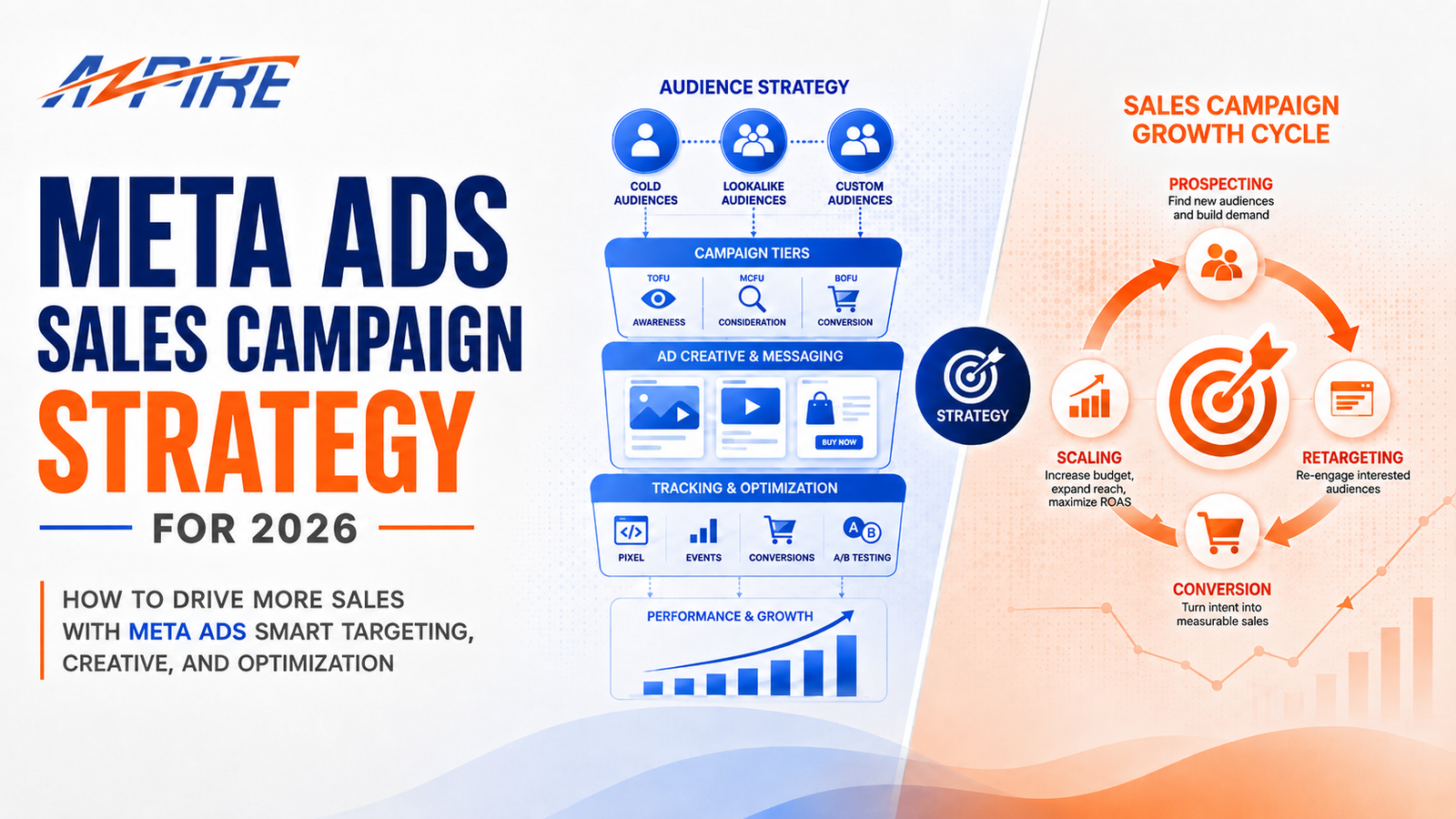
A modern Meta Ads sales campaign can be summarized as a continuous system :
Strong Offer → Diverse Creative → Accurate Tracking → Quality Signals → AI Learning → Sales → Better Customer Data → Smarter Optimization
Every stage strengthens the next.
Better creative generates better customer responses. Better tracking captures those responses. Better signals help AI understand valuable customers. Better optimization creates more conversions, which produces even more useful data.
This is why modern Meta advertising should be viewed as a learning system rather than a collection of individual campaign settings.
Final Thoughts
The Meta Ads sales strategy that worked several years ago may not work for businesses in 2026 as the effective strategy.
Meta is becoming increasingly AI-driven.
Audience discovery is broader. Campaign structures are becoming simpler. First-party data is more valuable. Conversion tracking matters more, and now automation is maintaining a larger part of campaign execution.
But technology does not remove the need for strategy.
Meta still needs advertisers to provide the right objective, high-quality creative, accurate conversion signals, and an offer customers genuinely want.
The future of Meta sales advertising therefore isn’t AI replacing advertisers.
It’s advertisers learning how to give AI better inputs while keeping humans responsible for the decisions that require real business understanding.
Scale Your Meta Sales Campaigns with Azpire
Scaling Meta Ads requires more than increasing campaign budgets.
Businesses need reliable advertising infrastructure, strong tracking, strategic campaign management, and a clear understanding of how Meta’s AI systems are changing.
Azpire provides Agency Ad Accounts, performance-focused media buying, and advertising solutions built for modern Meta campaigns.
Whether you’re launching a new sales campaign, moving toward Advantage+ automation, or expanding advertising into new markets, Azpire can help you build a stronger foundation for sustainable growth.
Explore Azpire’s Meta Advertising Solutions.
Frequently Asked Questions
What is a Meta Ads sales campaign?
A Meta Ads sales campaign is designed to optimize advertising delivery toward sales-related conversion events, such as purchases, using Meta’s advertising and machine-learning systems.
What is the best Meta sales campaign strategy in 2026?
A strong strategy combines a competitive offer, diverse creative, accurate tracking, quality conversion signals, simplified campaign structures, AI-powered optimization, and measurement based on actual business outcomes.
Are Advantage+ Campaigns better for sales?
Advantage+ can reduce manual campaign complexity and give Meta more flexibility to optimize delivery. However, performance still depends on factors such as data quality, creative, offer strength, tracking, budget, and customer experience.
Should I use Meta Pixel or Conversions API?
They do not have to be an either-or choice. Many advertisers use the Meta Pixel alongside the Conversions API to provide browser-side and server-side conversion signals.
How does first-party data improve Meta Ads?
First-party data can provide stronger information about customers, purchases, qualified leads, and customer value. This can help businesses improve measurement and provide Meta’s optimization systems with more meaningful signals.