

first party data meta adsfirst party data meta adsfirst party data meta adsfirst party data meta adsfirst party data meta adsfirst party data meta adsfirst party data meta adsfirst party data meta adsfirst party data meta adsfirst party data meta adsfirst party data meta ads
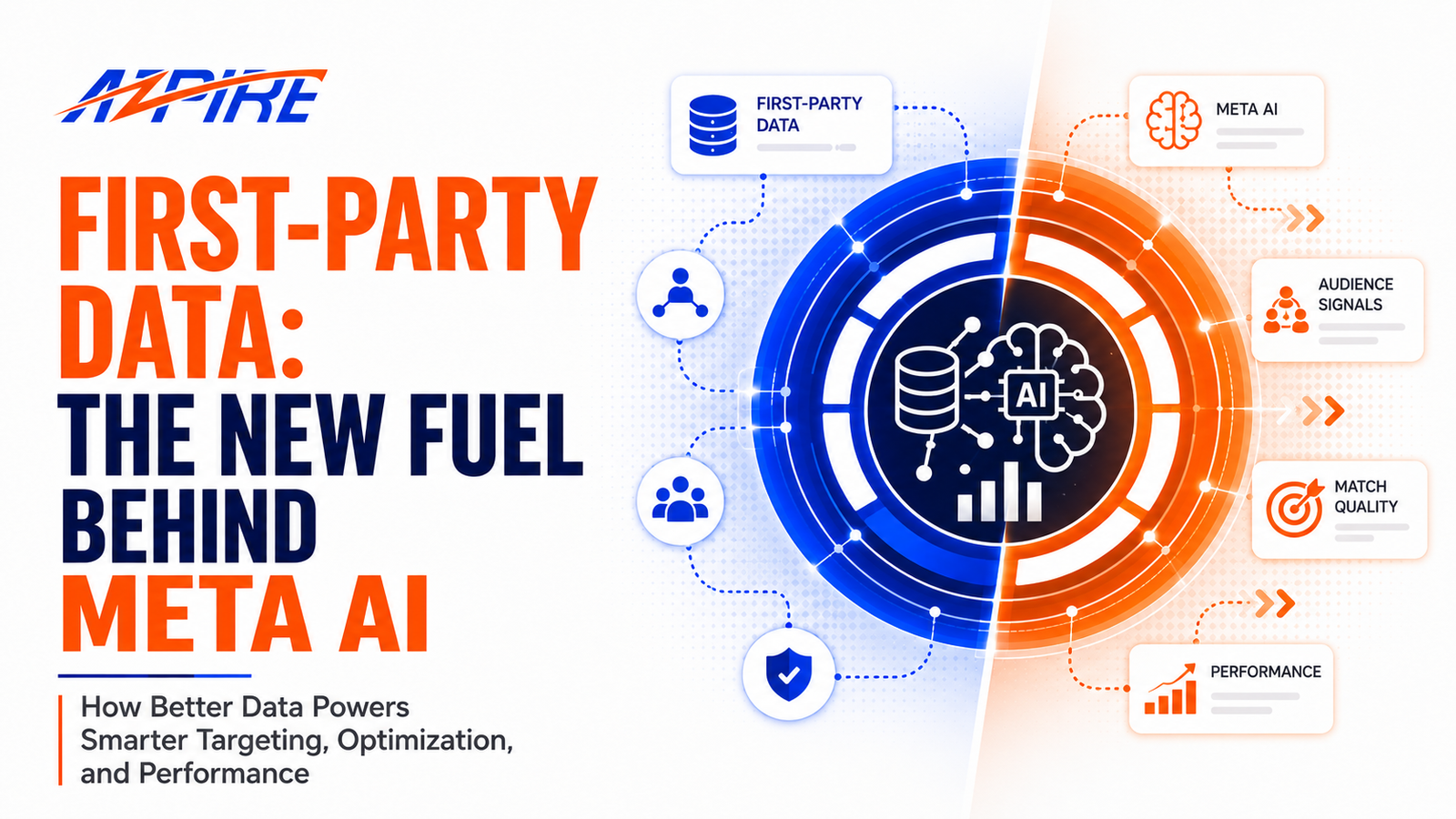
Automation is getting important in Meta advertising. But it creates a new challenge: AI needs high-quality data to make high-quality decisions.
Advertisers were fully dependent on platform targeting, browser tracking, third-party cookies, and manually selected interests to reach potential customers earlier.
That advertising environment is changing.
Privacy expectations are higher, browser-level tracking has become more restricted. Meta now increasingly uses artificial intelligence to make decisions about audience discovery, campaign delivery, budget allocation, and optimization.
As a result, businesses are now collecting information directly from their own customers which is becoming increasingly valuable.
This is where first party data Meta Ads strategies become important.
Purchase history, customer lists, CRM records, qualified leads, website conversions, repeat customers, and other direct customer interactions can provide Meta with stronger signals about what a valuable customer actually looks like.
The future of Meta advertising is therefore not simply about collecting more data.
It includes providing AI with better signals based on real customer outcomes.
What Is First-Party Data?
First-party data is information a business directly collects from customers, prospects, website visitors.
Unlike third-party information purchased or obtained from external sources, first-party data comes from the relationship between the business and its audience.
Examples may include :
- Customer email addresses
- Phone numbers
- Purchase history
- Website activity
- App activity
- CRM records
- Lead information
- Product preferences
- Repeat-purchase behaviour
- Customer lifetime value
- Qualified lead status
- Offline transactions
For Meta advertisers, this information can become especially useful when it helps the advertising system understand the difference between a random visitor and a valuable customer.
A website may receive thousands of visitors.
Only a small percentage may purchase.
Among those buyers, an even smaller group may become repeat customers.
If Meta receives stronger signals about these outcomes, its optimization systems have more meaningful information to learn from.
First-Party Data vs Third-Party Data
The difference is primarily about the source of the information.
First-party data comes directly from your business relationships and owned systems.
Third-party data traditionally comes from external sources that collect information across audiences or websites.
For example, a customer’s purchase record stored inside your ecommerce platform is first-party data.
A lead’s status inside your CRM is also first-party data.
Modern privacy-first advertising today is focusing fully on transparent, permission-aware relationships between businesses and their customers.
Businesses that build strong first-party data systems are now also developing an asset that can support marketing far beyond a single advertising campaign.
Why First-Party Data Matters More for Meta Ads in 2026
AI is increasingly being important in Meta advertising.
AI systems analyze signals to understand which users are more likely to convert.
But AI does not automatically know which customer is valuable to your specific business.
It needs signals.
Suppose two people submit a lead form.
The first never responds to the sales team.
The second books a meeting and becomes a high-value customer.
If Meta receives only the initial Lead event, both people may appear equally valuable from the campaign’s perspective.
But they are not equally valuable to the business.
Connecting deeper customer outcomes can help create a more accurate picture.
This is why first-party signals are becoming increasingly important.
Instead of telling Meta only that someone converted, businesses can build measurement systems that better reflect what happened after the initial conversion.
How Meta AI Uses Customer Signals
Meta’s advertising system uses machine learning to predict the likelihood that users will take particular actions.
Advertisers contribute to this process through campaign objectives, conversion events, customer audiences, website activity, app events, and other available business signals.
The stronger those signals are, the more context the optimization system can potentially work with.
Customer Lists and Custom Audiences
Businesses can use eligible customer information to create Custom Audiences.
This may help with activities such as :
- Reaching existing customers
- Re-engaging previous buyers
- Excluding certain existing customers from acquisition activity
- Building Lookalike Audiences
- Providing audience suggestions to AI-powered targeting systems
Customer lists are useful as they represent people who already have a relationship with the business.
Instead of starting entirely from assumptions about interests, advertisers can use real customer relationships as an input.
Purchase and Conversion Signals
Purchase information provides another valuable signal.
A completed purchase is generally more meaningful to a sales campaign than a simple page visit.
However, even purchase data can be improved.
Businesses may know :
- Which customers spend more
- Which products have better margins
- Which customers purchase repeatedly
- Which customers refund
- Which buyers become long-term customers
This creates an opportunity to move from basic conversion optimization toward customer-value optimization.
First-Party Data and Meta AI Targeting
Modern Meta AI Targeting is increasingly less dependent on advertisers manually discovering the perfect interest combination.
Systems such as Advantage+ Audience can use advertiser inputs and broader machine-learning signals to discover potential customers.
First-party information can provide useful context within this environment.
For example, instead of telling Meta only : “Find people interested in ecommerce.”
A business may be able to provide signals based on people who actually purchased from its ecommerce store.
That is a much stronger commercial relationship.
The goal is not to eliminate human audience strategy.
It is to move from assumption-based targeting toward evidence-based targeting.
Human marketers understand the market.
First-party data describes actual customers.
Meta AI processes patterns at scale.
Used together, these elements can create a stronger targeting system.
How Conversion API Connects First-Party Data with Meta
Collecting customer data is only a part of the full process.
Businesses also need appropriate ways to send relevant conversion signals into their advertising ecosystem.
This is where the Conversions API becomes important.
CAPI can create a direct connection between business data and Meta’s systems rather than relying entirely on browser-side tracking.
For example, an ecommerce server may send purchase information.
A CRM-integrated lead generation system may send later-stage conversion information when technically and legally appropriate.
This creates a natural connection between first-party data and server-side tracking.
As discussed in our Conversion API vs Meta Pixel guide, CAPI does not necessarily replace browser tracking. A properly configured setup can use multiple signal sources together.
The objective is to create more reliable measurement—not simply to collect more information.
First-Party Data for Ecommerce Meta Ads
Ecommerce businesses can generate particularly rich first-party datasets.
Every customer journey may provide information such as :
Product View → Add to Cart → Checkout → Purchase → Repeat Purchase
Instead of treating every purchase identically, advanced businesses can analyse which customers create the most value.
For example, one customer may purchase a low-margin product once.
Another may purchase several high-margin products throughout the year.
The second customer is significantly more valuable.
Audience strategy, reporting, retention campaigns, and broader advertising decisions can be improved by this type of customer intelligence.
New Customers vs Existing Customers
Businesses can distinguish between acquisition and retention using first-party data.
Without this distinction, a campaign may appear to generate excellent sales while a large percentage of those purchases come from people who were already customers.
That is not necessarily bad.
But it is different from acquiring genuinely new customers.
Businesses should understand whether advertising is generating :
- New customers
- Returning customers
- High-value customers
- Reactivated customers
That context creates better decision-making than looking at total purchases alone.
First-Party Data for Lead Generation
For lead generation businesses, first-party data may be even more important.
The initial lead is rarely the final business outcome.
Consider this journey : Ad → Form Submission → Sales Call → Qualified Lead → Proposal → Customer
If Meta receives information only about the form submission, campaign optimization stops at the first stage.
The business, however, cares about the final customer.
A stronger CRM and measurement strategy allows advertisers to evaluate campaign performance deeper into the sales funnel.
Instead of focusing only on cost per lead, teams can analyze :
- Cost per qualified lead
- Cost per booked appointment
- Cost per sales opportunity
- Cost per customer
- Revenue per lead source
This helps connect Meta Ads performance with actual sales performance.
Data Quality Matters More Than Data Volume
A common misconception is that AI simply needs more data.
It needs useful data.
Sending thousands of low-value events does not necessarily create better optimization.
For example, a campaign generating 1,000 cheap leads may appear successful.
But if only five are qualified, optimizing toward all 1,000 leads could teach the system to find more people who submit forms—not necessarily people who become customers.
This is why businesses should think carefully about what each conversion signal represents.
Better questions include :
- Does this event represent real customer intent?
- Can we identify qualified outcomes?
- Are purchase values accurate?
- Are duplicate events being removed?
- Is our CRM data clean?
- Are we optimizing toward revenue or surface-level activity?
The future of AI advertising will increasingly reward signal quality over signal quantity.
Privacy-First Advertising and Customer Trust
First-party data strategy should maintain privacy issues.
Businesses cannot use customer information without their permission violating privacy.
Businesses should collect and process customer information transparently and in accordance with applicable privacy laws, consent requirements, platform policies, and their own privacy commitments.
A sustainable privacy-first advertising strategy should focus on information customers intentionally provide through genuine business interactions.
This creates a healthier long-term model than depending on opaque data collection.
Customer trust is not separate from marketing performance.
It is part of it.
Common First-Party Data Mistakes
Businesses often possess valuable customer information but fail to use it effectively.
Common mistakes include :
- CRM records that are never cleaned
- Duplicate customer information
- Incorrect conversion values
- No distinction between good and bad leads
- Tracking only initial conversions
- Poor Pixel or CAPI implementation
- No separation between new and existing customers
- Collecting data without a clear purpose
- Ignoring privacy and consent requirements
Another major mistake is relying on technology fully.
A CRM, Meta Pixel, or CAPI integration is useful only when the information flowing through it is meaningful and accurate.
A First-Party Data Strategy for Meta Ads
Businesses do not need a massive data infrastructure to start improving their signals.
A practical strategy can follow this process : Collect → Organize → Qualify → Connect → Optimize → Measure
First, identify the customer information the business already owns.
Next, organize it inside appropriate systems such as an ecommerce platform or CRM.
Then distinguish valuable outcomes from surface-level actions.
Connect relevant signals to Meta using suitable tools and integrations.
Finally, evaluate whether campaigns are improving actual business outcomes.
The goal is to create a feedback loop : Meta Ads → Customer → Business Data → Better Signals → Meta AI → Better Customer Discovery
As this loop improves, advertising decisions become less dependent on assumptions.
The Future of First-Party Data and Meta AI
As Meta continues expanding automation, advertisers will likely have fewer reasons to manually control every delivery decision.
But this does not reduce the importance of advertiser input.
It increases it.
Now AI is capable of handling more targeting, placement, budget, and optimization decisions. Meanwhile businesses should become better at providing the system with information about what success actually means.
This creates a new competitive advantage.
The best advertiser may no longer be the person who knows the most hidden targeting tricks.
It may be the business with :
- Better customer data
- Better conversion tracking
- Better creative
- Better CRM information
- Better understanding of customer value
- Better feedback between marketing and sales
Meta AI becomes more powerful when businesses become better at defining value.
Final Thoughts
First-party data is becoming one of the most valuable assets in modern Meta advertising.
Not because it replaces AI.
Because AI is being more useful because of first party data.
Now Meta’s machine-learning systems can process enormous amounts of information. Meanwhile businesses should focus on providing meaningful signals about their customers and outcomes.
For advertisers, the shift is clear.
Move beyond clicks.
Move beyond basic leads.
Move beyond isolated purchase events.
Understand which customers create real value and build measurement systems that reflect those outcomes.
When first party data Meta Ads strategy, Conversion API, accurate tracking, strong creative, and Meta AI work together, advertising becomes a continuous learning system rather than a collection of disconnected campaigns.
Build Smarter Meta Advertising with Azpire
Modern Meta advertising requires more than campaign setup.
An increasingly AI-powered advertising environment requires the right infrastructure, reliable signals, strong measurement, and a strategy.
Azpire helps businesses scale through Agency Ad Accounts, performance-focused media buying, and modern Meta advertising solutions.
Whether you’re strengthening your first-party data strategy, scaling a Meta Ads Sales Campaign, or moving toward AI-powered optimization, Azpire can help you build a stronger advertising foundation.
Explore Azpire’s Meta Advertising Solutions.
Frequently Asked Questions
What is first-party data in Meta Ads?
First-party data is customer or prospect information a business collects directly through its own interactions, such as purchases, CRM records, customer lists, website conversions, and qualified lead information.
Why is first-party data important for Meta AI?
First-party data can provide Meta with useful signals about real customer behaviour and business outcomes, helping advertisers move beyond assumptions and optimize around more meaningful conversions.
How can first-party data improve Meta Ads targeting?
Customer lists, conversion events, purchase information, and qualified lead data can provide stronger audience and optimization signals that complement Meta’s AI-powered targeting systems.
Is first-party data the same as Meta Pixel data?
No. First-party data is a broader category of information collected directly by a business. Meta Pixel is one method for capturing certain website events that can become part of a business’s measurement setup.
Does Conversions API use first-party data?
Conversions API can be used to send eligible business and conversion data directly to Meta. The exact data sent depends on the implementation, business systems, consent requirements, and applicable privacy rules.