You launch a new Meta Ads campaign, wait for the first results, and immediately notice that performance is unstable.
One day, the cost per lead looks promising. The next day, it increases. One creative receives most of the budget, while another barely spends. Your dashboard may also show a status called “Learning” or “Learning Limited.”
This can make advertisers feel that something is wrong.
In many cases, however, the campaign is simply going through the Meta Ads learning phase.
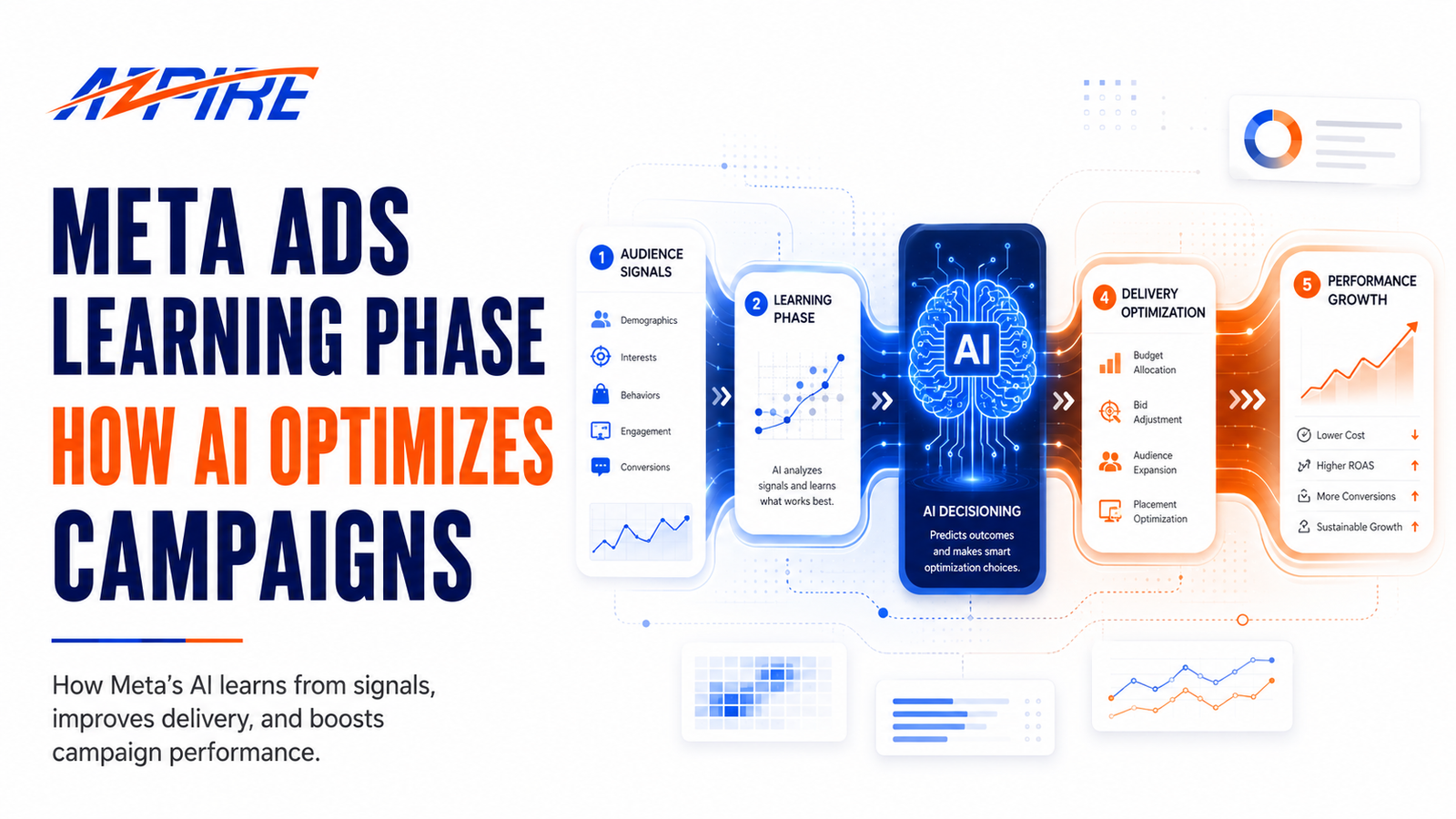
Meta’s delivery system focuses on serving your ads more effectively in the learning phase. It tests different audiences, placements, creative combinations, and delivery opportunities to understand which users are most likely to complete the action you selected.
Performance is usually less stable, and the cost per result may increase in this time. Meta officially describes the Learning status as a stage where its system is still exploring and optimizing delivery.
This does not mean advertisers should ignore campaign performance.
It means they should understand how campaign learning works before making frequent changes that interrupt the optimization process.
What Is the Meta Ads Learning Phase?
The Meta Ads learning phase begins when a new ad set starts delivering or when an existing ad set experiences a significant change.
During this stage, Meta’s AI collects information about how people respond to the campaign.
It attempts to identify patterns such as :
- Which users are more likely to convert
- Which placements generate efficient results
- Which creative assets receive stronger responses
- Which times or delivery opportunities perform better
- Which audience signals are associated with the selected objective
Meta explains that ad sets enter an initial learning period so its delivery system can explore which audiences and placements are most effective. The company recommends simplifying account structures and limiting unnecessary changes so the system can learn more efficiently.
The campaign is not simply waiting for a fixed number of days.
It is gathering evidence.
The more useful conversion signals the system receives, the better it can predict where the next result may come from.
What Meta AI Learns During This Period
Meta’s delivery system uses machine learning to estimate which advertisement should be shown to which person at a particular moment.
Its ad auction considers factors such as the advertiser’s bid, the estimated likelihood that a user will take action, and the expected quality of the advertisement. Meta’s machine-learning models continuously update as they receive new information.
During campaign learning, the system may test different combinations of :
- Audience characteristics
- Feed, Stories, Reels, Messenger, and other placements
- Devices and viewing environments
- Creative formats
- Conversion opportunities
- Budget distribution
Suppose an ecommerce campaign is optimized for purchases.
Meta may initially deliver ads across several placements and audience groups. As purchase data appears, its AI begins identifying which patterns are more strongly connected to completed orders.
The system may discover that one type of creative performs better in Instagram Reels, while another produces more purchases from Facebook Feed.
It may also identify customers outside the audience assumptions originally made by the advertiser.
This is one reason modern Meta AI targeting and Advantage+ Audience rely on broader exploration. Meta says Advantage+ Audience can use advertiser suggestions as guidance and expand beyond them when its system predicts that wider delivery may improve results.
Why Campaign Performance Fluctuates
Performance fluctuation is normal during campaign learning.
Meta’s AI is still testing delivery opportunities, so spending and results may not be distributed evenly.
For example, you may notice :
- A sudden increase or decrease in cost per result
- One ad receiving more budget than others
- Daily conversion volume changing
- Certain placements performing differently
- Return on ad spend moving up and down
This does not automatically mean the campaign has failed.
The system may still be determining which combinations are most likely to produce the desired result.
Meta notes that performance is generally less stable during the learning phase and that cost per action is often worse during this period.
The mistake many advertisers make is reacting to every daily movement.
They change the audience.
Then they change the creative.
Then they increase the budget.
Then they adjust the optimization event.
Each major change can force the delivery system to reassess the campaign, delaying stability.
It is better to judge performance over a meaningful period while monitoring whether the campaign is gathering enough high-quality data.
How Meta AI Optimizes Campaigns
Meta AI optimization is based on multiple factors.
The system combines audience, placement, creative, conversion, and auction signals to determine where the campaign has the best chance of achieving its objective.
The advertiser chooses the desired outcome.
Meta AI then tries to find the most efficient delivery opportunities.
For a traffic campaign, that may mean users likely to click.
For a lead campaign, it may mean users likely to submit a form.
For a sales campaign, it may mean users likely to purchase or generate conversion value.
This is why choosing the correct optimization event is so important.
If the campaign is optimized for a weak or low-value event, Meta may become very efficient at generating that event without improving actual business results.
Audience and Behavioral Signals
Meta’s AI studies user’s behavioral signals to know how users interact with content and advertisements across its ecosystem.
It may analyze patterns connected to:
- Previous engagement
- Website or app activity
- Purchase behaviour
- Video viewing
- Form submissions
- Customer lists
- Lookalike patterns
- Campaign conversion history
The system does not simply target someone because they match one interest.
It attempts to estimate the probability that the person will complete the selected action.
This is a major difference between AI-led targeting and traditional manual targeting.
Manual targeting begins with advertiser assumptions.
AI optimization learns from campaign behaviour.
The strongest campaign setups often combine both: human knowledge defines the business objective and essential restrictions, while AI receives enough flexibility to discover additional conversion opportunities.
Placement and Delivery Optimization
Now Meta can decide where an advertisement is most likely to perform efficiently using AI.
Ads may be delivered across Facebook, Instagram, Messenger, Reels, Stories, Feed, and the Meta Audience Network using advantage+ placements. Automated placements create more efficient opportunities for its system to find lower-cost results.
This does not mean every placement will receive equal spending.
The system may direct more delivery toward placements producing stronger predicted outcomes.
Instagram Stories or Facebook Feed may perform better for one campaign, while Reels may perform better for another.
The system collects enough evidence to make those decisions more confidently.
Conversion and Creative Signals
Meta AI needs accurate conversion signals to understand what success looks like.
The Meta Pixel, Conversions API, app events, offline conversions, CRM data, and lead-quality information can all help the system connect ad interactions with business outcomes.
Meta states that the Conversions API creates a more direct connection between business data and its optimization systems, helping improve targeting, measurement, and cost efficiency.
Creative signals are equally important.
Meta observes how different users respond to different messages, formats, and visuals.
One person may react to a product demonstration.
Another may respond to a testimonial.
Someone else may convert after seeing a direct offer.
Creative diversity gives Meta AI more options to match the right message with the right user.
However, adding many nearly identical creatives does not automatically improve learning.
Each asset should provide a meaningful variation in angle, format, message, or customer motivation.
How Long Does the Meta Ads Learning Phase Last?
There is no guaranteed learning-phase timeline that applies to every campaign.
Some campaigns stabilize relatively quickly.
Others remain in learning for longer because they generate limited optimization events, use small budgets, target narrow audiences, or experience frequent edits.
The duration depends on factors such as :
- Budget
- Conversion volume
- Audience size
- Optimization event
- Campaign structure
- Tracking quality
- Creative performance
- Frequency of edits
A campaign optimized for a high-volume event may gather data faster than one optimized for a rare purchase or qualified lead.
That does not mean advertisers should automatically choose an easier event.
The selected event must still represent a valuable business outcome.
Why There Is No Guaranteed Timeline
Campaign learning is based on data, not just time.
A campaign can run for several days and still receive too few meaningful results to stabilize.
Another campaign may gather useful conversion data more quickly because it has sufficient budget, strong creative, reliable tracking, and a larger audience.
This is why advertisers should not ask only : “How many days has the campaign been running?”
They should also ask : “Is the campaign generating enough useful signals for Meta to learn from?”
Optimization Events and Campaign Stability
The optimization event tells Meta which action matters most.
Examples include :
- Landing page views
- Leads
- Purchases
- Add-to-cart events
- App installs
- Qualified leads
- Conversion value
If the chosen event rarely occurs, the campaign may struggle to gather enough data.
For example, a new business may optimize for purchases but receive only one or two purchases per week.
In this case, Meta’s AI has limited information about what a buyer looks like.
The advertiser may need to improve their offer, increase budget, strengthen creative, broaden the audience, consolidate ad sets, or temporarily select a more achievable event that still reflects meaningful intent.
The solution should not be to chase cheap activity that has no business value.
The goal is to create enough reliable signals for AI optimization while keeping the campaign aligned with the actual objective.
What Does Learning Limited Mean in Meta Ads?
One of the most misunderstood campaign statuses in Meta Ads Manager is Learning Limited.
Many advertisers assume this status means the campaign has failed or that Meta’s AI is no longer optimizing.
That is not true.
Learning Limited simply means the delivery system expects the ad set to receive too few optimization events to complete the learning process efficiently. As a result, Meta’s AI receives less data to understand user behavior.
The campaign can still generate leads, sales, or purchases.
However, without enough learning signals, performance is often less predictable and harder to scale.
Think of it like teaching a new employee.
Someone who completes ten tasks learns much faster than someone who completes only one.
Meta AI works in a similar way. The more meaningful conversion data it receives, the more accurately it can predict future results.
Common Causes of Learning Limited
Several factors can prevent Meta’s AI from collecting enough optimization data.
Common reasons include :
- Very small campaign budgets
- Highly restricted audiences
- Low conversion volume
- Too many separate ad sets
- Rare optimization events
- Frequent campaign edits
- Weak creatives that generate little engagement
Many advertisers unintentionally create these problems by splitting campaigns into numerous audience groups.
Instead of allowing one campaign to collect strong learning signals, the available budget and conversions become fragmented across multiple ad sets.
The result is slower optimization.
In many cases, simplifying campaign structure is more effective than creating additional audience segments.
Does Learning Limited Mean Campaign Failure?
Absolutely not.
Some profitable campaigns remain in a Learning Limited state for extended periods, particularly in industries with low conversion volume or high-value purchases.
For example, a business selling enterprise software or industrial equipment may only generate a few qualified leads each month.
That does not mean the advertising is unsuccessful.
The campaign simply produces fewer optimization events than Meta ideally prefers.
Instead of focusing only on campaign status, advertisers should evaluate :
- Cost per qualified lead
- Customer acquisition cost
- Return on ad spend (ROAS)
- Revenue generated
- Lead quality
- Overall profitability
Business results matter far more than a single dashboard label.
Which Changes Can Reset the Learning Phase?
Meta’s AI continuously builds knowledge about how your campaign performs.
When major changes are made, much of that learning may no longer be relevant.
As a result, the campaign can re-enter the Meta Ads learning phase while the system collects fresh optimization data.
This is why unnecessary edits should be avoided.
Every major reset delays campaign stability.
Significant Budget Changes
Advertisers often make mistakes by adjusting budgets too frequently.
Increasing or decreasing the budget every day prevents Meta from establishing stable delivery patterns.
Allow enough time before making budget adjustments if campaign performance changes naturally.
Scaling gradually is more effective than making sudden budget increases.
Patience often produces better long-term performance than constant optimization attempts.
Audience, Creative and Optimization Changes
Budget is not the only factor that affects campaign learning.
Other significant edits may also restart optimization, including :
- Changing the target audience
- Replacing creative assets
- Changing the conversion objective
- Modifying optimization events
- Adding or removing ads
- Creating major structural changes inside the campaign
This does not mean campaigns should never be improved.
It simply means meaningful changes should be made strategically instead of reacting to every daily fluctuation.
Successful advertisers optimize based on trends—not emotions.
How to Exit the Meta Ads Learning Phase Faster
Although no advertiser can completely control Meta’s learning process, they can create conditions that help AI gather better optimization signals.
The goal is not to force the campaign out of learning.
The goal is to make learning easier.
Consolidate Campaign Structure
Avoid creating unnecessary campaigns and dozens of small ad sets.
A simpler campaign structure allows Meta’s AI to collect more data in one place instead of spreading conversions across multiple audiences.
Consolidated campaigns often stabilize faster because the learning system receives stronger optimization signals.
Choose a Realistic Conversion Event
Your optimization event should reflect real business value.
However, it also needs enough conversion volume for Meta to learn effectively.
For new advertisers, optimizing for a very rare event may slow campaign learning considerably.
Rather than chasing meaningless clicks, select an event that balances business value with achievable conversion frequency.
As campaign performance improves, optimization goals can become more advanced.
Avoid Frequent Campaign Edits
One of the easiest ways to improve campaign stability is simply leaving successful campaigns alone.
Many advertisers make daily adjustments after seeing one day of weak performance.
Meta’s AI evaluates patterns across much larger datasets than individual daily results.
Only edit when there is any serious issue while the campaign is still gathering data.
Consistency allows the algorithm to optimize more effectively.
Improve Tracking and Signal Quality
AI depends on data quality.
If Meta receives incomplete or inaccurate conversion information, optimization becomes much more difficult.
Businesses should ensure that :
- Meta Pixel is correctly configured
- Conversions API is implemented where appropriate
- Important conversion events are tracked accurately
- CRM or offline conversion data is connected when available
- High-quality leads are distinguished from low-quality enquiries
Better signals allow Meta to optimize toward customers who actually create business value—not just inexpensive clicks or form submissions.
Common Meta Ads Learning Phase Mistakes
Many advertisers unintentionally slow down campaign optimization by making avoidable mistakes.
Some of the most common include :
- Judging campaigns after only one or two days
- Editing budgets repeatedly
- Creating too many audience segments
- Optimizing for the wrong conversion event
- Using poor-quality creatives
- Ignoring landing page experience
- Focusing on only dashboard metrics rather than business outcomes
AI cannot bring good results for weak marketing fundamentals.
The algorithm performs best when it receives strong creative assets, accurate tracking, meaningful conversion data, and a compelling offer.
How Advantage+ Campaigns Use the Learning Phase
Advantage+ Campaigns are built around Meta’s AI optimization system.
Instead of relying heavily on manual audience selection and placement decisions, these campaigns allow the algorithm to gather data from a broader range of delivery opportunities.
During the learning phase, Meta evaluates :
- Audience behavior
- Creative performance
- Placement efficiency
- Conversion quality
- Budget allocation
As more data becomes available, the system gradually shifts delivery toward combinations that are producing stronger results.
This is one reason Advantage+ Campaigns often perform best when advertisers avoid unnecessary restrictions.
AI can learn more efficiently if more flexibility is given while working within meaningful business constraints.
Final Thoughts
The Meta Ads learning phase is not something advertisers should fear.
It is an important part in optimizing campaign delivery using Meta AI.
The system identifies where your advertising budget can make the best results testing audience behavior, creative performance, conversion signals, placements, and other factors.
Trying to rush this process through constant edits often creates the opposite outcome.
The advertisers who achieve the strongest long-term performance are usually those who provide Meta with :
- Accurate tracking
- High-quality conversion data
- Strong creative assets
- Clear business objectives
- Enough time to learn
AI optimization mostly works if it is made with smart human strategy.
Build campaigns that help Meta learn faster & make better decisions rather than struggling in the learning phase.
Scale Smarter with Azpire
Advertisers don’t need to adjust everything manually to make the Meta Ad successful.
AI gets the right data, the right signals, and the right strategy if campaigns are built successfully.
At Azpire, we provide Agency Ad Accounts, AI-powered Meta advertising strategies, and performance-driven campaign management that delivers sustainable business growth.
If you’re struggling with the Meta Ads learning phase, improving campaign performance, or scaling with Advantage+ Campaigns, our team can help you build campaigns designed for long-term success.
Explore Azpire’s Meta Advertising Solutions
Frequently Asked Questions
What is the Meta Ads learning phase?
The Meta Ads learning phase is the period when Meta’s AI collects campaign data and tests different audiences, placements, and creative combinations to optimize ad delivery.
How long does the Meta Ads learning phase last?
There is no fixed timeline. The duration depends on factors such as conversion volume, campaign budget, audience size, tracking quality, and the frequency of campaign changes.
What does Learning Limited mean in Meta Ads?
Learning Limited means Meta expects the campaign to receive too few optimization events for its AI to learn efficiently. It does not necessarily mean the campaign is failing.
Can changing my budget reset the learning phase?
Yes. Significant budget changes, major audience edits, optimization-event changes, or large creative updates can cause an ad set to re-enter the learning phase.
How can I exit the Meta Ads learning phase faster?
You can help Meta learn more efficiently by simplifying your campaign structure, using accurate tracking, choosing a realistic optimization event, avoiding frequent edits, and generating consistent conversion data.