
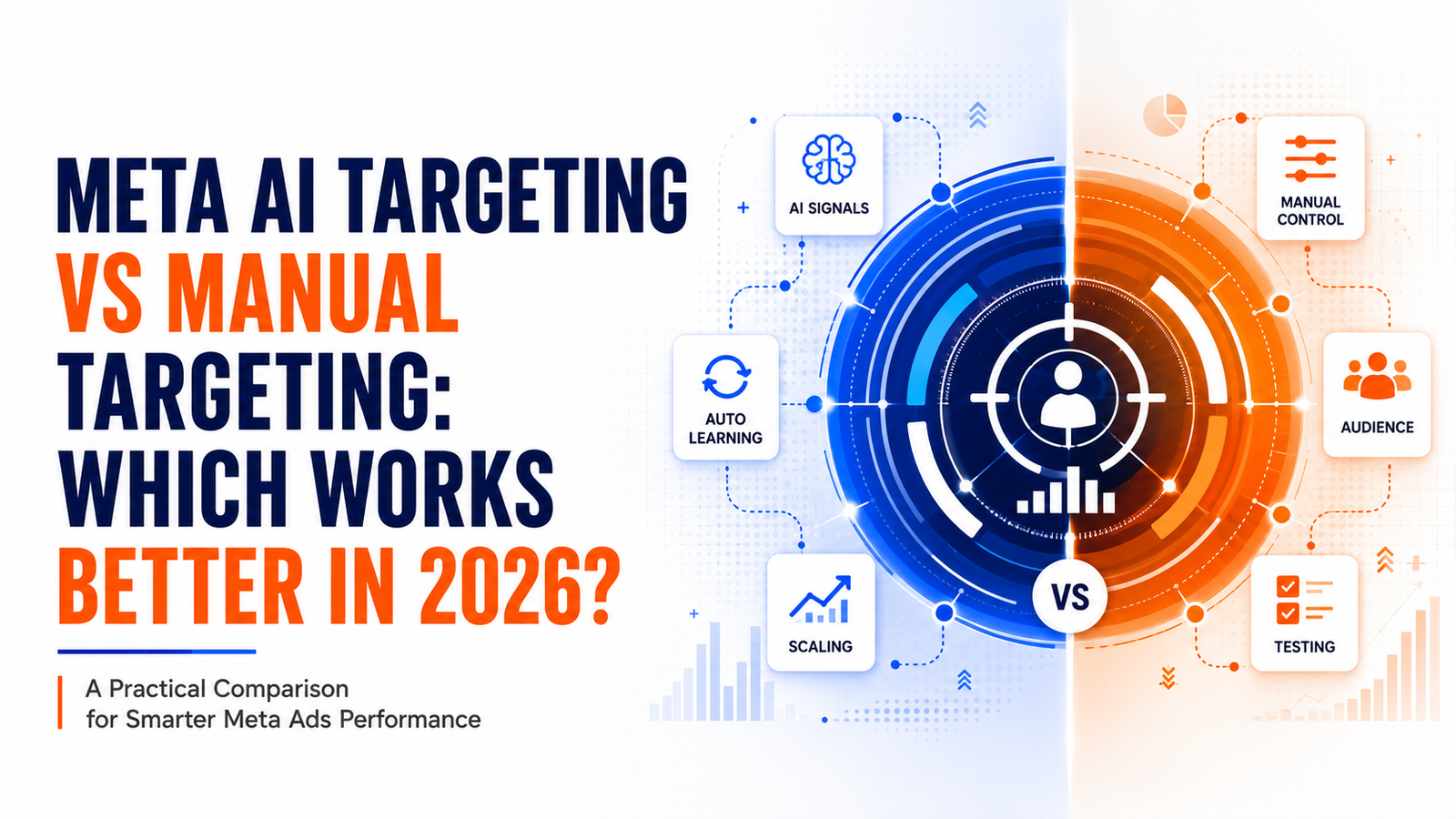
For years, successful Meta advertising depended heavily on audience research.
Media buyers spent hours identifying interests, building Lookalike Audiences, excluding irrelevant users, and dividing campaigns into carefully controlled ad sets.
That approach is changing.
In 2026, Meta AI targeting plays a much larger role in deciding who sees an advertisement. Instead of depending only on the interests and demographic criteria selected by an advertiser, Meta’s advertising system can analyze conversion behavior, engagement patterns, customer data, creative responses, and other signals to find people who are likely to take action.
This does not mean manual targeting has completely disappeared.
Now advertisers can also use location, age, language, Custom Audiences, Lookalike Audiences, interests, and behavioural criteria for better campaign setups. However, Meta increasingly treats many audience selections as suggestions that its AI can expand beyond when broader delivery is expected to improve performance.
So, which strategy works better?
The strategy works better if the objective, data quality, audience size, market, and maturity of your campaign is good enough. Meta AI targeting is generally stronger for scalable performance, while manual targeting remains useful when genuine business restrictions or controlled testing require tighter audience definition.
Why Meta Ads Targeting Is Changing
Traditional targeting was built based on a simple assumption: advertisers know their customers better than the advertising platform.
That assumption is still partly true. A business understands its products, market, positioning, and ideal customer in ways an algorithm cannot fully understand.
However, Meta has access to a scale of behavioural data that no individual advertiser can analyse manually.
Its delivery system can observe which users click, watch, engage, submit forms, purchase products, and respond to specific creative formats. It can then use those patterns to predict who is more likely to complete the campaign’s chosen objective.
Meta generally encourages advertisers to avoid unnecessarily narrow audiences because broader audience pools give its delivery system more opportunities to observe results and optimize.
From Interest Targeting to Behavioral Prediction
Interest targeting is based on categories.
An advertiser may target people interested in digital marketing, skincare, real estate, business software, online shopping, or entrepreneurship.
But it doesn’t mean they are ready to buy.
Meta AI targeting goes further by evaluating patterns associated with the campaign objective. Rather than asking only, “What is this person interested in?”, the system attempts to answer, “How likely is this person to take the action the advertiser wants?”
That difference is important.
Someone may not appear inside an obvious interest group but may behave similarly to customers who frequently purchase your type of product. AI targeting can potentially identify that opportunity, while a tightly restricted interest audience may exclude it.
What Is Meta AI Targeting?
Meta AI targeting is the use of machine learning to identify and reach users who are likely to complete a selected advertising objective.
The advertiser still provides important inputs, such as :
- Campaign objective
- Conversion event
- Geographic restrictions
- Customer lists
- Audience suggestions
- Creative assets
- Budget
- Historical campaign data
Meta’s system then uses those inputs to optimize ad delivery.
One of the clearest examples is Advantage+ Audience. Advertisers can also add suggestions like interests, demographics, Custom Audiences, Lookalike Audiences etc. Meta may prioritise people matching those suggestions before searching more broadly when its system predicts that expansion could improve performance.
How Advantage+ Audience Uses Advertiser Input
Advantage+ Audience does not necessarily ignore your customer knowledge.
Instead, it can use your selections as guidance.
You might provide a customer list, a Lookalike Audience, an age range, or detailed targeting criteria. Meta’s AI can begin with those signals but explore outside them when additional users appear likely to deliver lower-cost or higher-quality outcomes.
Advertisers can still maintain stricter controls for genuine business constraints, including location, minimum age, language, and certain Custom Audience exclusions.
This creates a hybrid system.
The advertiser defines the business context, while AI handles more of the audience discovery.
What Is Manual Targeting in Meta Ads?
Manual targeting means the advertiser defines more of the audience criteria directly.
This may include :
- Location
- Age
- Gender
- Language
- Interests
- Behaviours
- Custom Audiences
- Lookalike Audiences
- Saved Audiences
With manual targeting Meta Ads, the campaign is built around the advertiser’s assumptions about who the ideal customer is.
This can provide greater control and clearer audience segmentation. It can also make structured testing easier because each audience can be separated into its own ad set.
However, excessive audience restrictions can reduce delivery opportunities and prevent the system from finding converters outside your original assumptions.
Detailed Targeting
Detailed targeting Meta Ads allows advertisers to include people based on available demographics, interests, or behaviors.
It remains useful when the selected interests are closely connected to the product or service.
For example, a specialist software provider may want to test professionals associated with a relevant industry. A local training center may target people interested in a specific certification. A luxury brand may want to test audience groups connected to premium purchasing behavior.
But detailed targeting is not perfect.
Interests can be broad, outdated, or only loosely related to purchase intent. Even when an audience appears strategically accurate, it may not outperform a broader AI-led setup.
Meta has also gradually reduced some manual targeting flexibility, reflecting the platform’s wider shift toward simpler and more automated audience systems.
Meta AI Targeting vs Manual Targeting
If we want to identify which one is better, examining how two approaches perform access control, accuracy, scalability, learning, and management is the best way to compare them.
Audience Control
Manual targeting gives advertisers more visible control.
You can decide which interests to include, which age groups to focus on, and how different audience segments should be separated.
Meta AI targeting gives the platform greater flexibility.
The advertiser may provide suggestions, but Meta can expand beyond those suggestions when it predicts better results.
For brands with strict audience requirements, manual control can be valuable. For brands focused primarily on performance and scale, broader AI-led targeting may create more opportunities.
Targeting Accuracy
Manual targeting can look highly accurate on paper.
An advertiser may select interests that perfectly describe the expected customer.
But theoretical relevance does not always translate into conversions.
Meta AI targeting uses actual campaign behavior to improve delivery. If enough high-quality conversion signals are available, it can learn which patterns are associated with buyers or qualified leads.
AI targeting is becoming more accurate over time not because it understands the brand better. but because it can process more behavioral evidence.
Scalability
AI targeting generally has a clear advantage when scaling.
Manual audiences can become saturated. Costs may rise as the same people see advertisements repeatedly, and advertisers may struggle to find additional interest groups.
Broader targeting gives Meta a larger pool of potential customers. It can continue exploring new users instead of being restricted to a narrow audience definition.
This is also why Advantage+ Campaigns and other Meta automation products increasingly combine audience, placement, and budget optimization.
Learning Speed
Campaigns need conversion data to optimize effectively.
When a campaign is divided into too many narrow ad sets, each ad set may receive limited data. That fragmentation can slow down learning.
A broader and more consolidated campaign may allow the system to gather stronger signals in one place.
However, AI targeting does not automatically guarantee fast learning. Low budgets, weak conversion volume, poor tracking, and frequent campaign edits can still delay stabilization.
Advertisers should understand the Meta Ads Learning Phase before assuming that automation will immediately solve performance problems.
Campaign Management
Manual targeting usually requires more active management.
Media buyers may need to :
- Create multiple audience groups
- Monitor audience overlap
- Shift budgets
- Pause underperforming ad sets
- Test new interests
- Manage exclusions and segmentation
Meta AI targeting can simplify this structure.
Instead of managing many small audiences, advertisers can focus more on creative quality, offer development, conversion tracking, landing page experience, and profitability.
This does not mean AI campaigns should be ignored after launch.
Automation reduces unnecessary adjustments, but strategic monitoring remains essential.
When Meta AI Targeting Usually Works Better
Meta AI targeting is often the stronger option when a campaign has enough reliable data and a scalable business objective.
Ecommerce and High-Volume Sales
Ecommerce advertisers frequently generate more conversion data than low-volume businesses.
Purchases, add-to-cart activity, product views, customer lists, and catalogue interactions can give Meta useful signals.
A broad or Advantage+ Audience setup may help the system identify customers beyond the interests an advertiser would manually select.
Lead Generation with Quality Signals
AI targeting can also work well for lead generation, especially when the advertiser tracks more than form submissions.
Meta can optimize toward stronger business outcomes if it receives information about which leads become qualified, book consultations, or make purchases.
Connecting first-party CRM data and the Conversions API can help the system understand which leads create actual value for the business.
Scaling Proven Campaigns
When an offer and creative concept have already produced consistent results, broader targeting can help the campaign reach new customers.
Instead of searching for another narrow interest group, advertisers can give the system more freedom to identify people who resemble previous converters.
When Manual Targeting Can Still Work Better
Manual targeting remains valuable when control serves a clear strategic purpose.
Niche B2B Campaigns
A small group of decision-makers require a specialized B2B service.
Industrial equipment, enterprise software, legal services, or highly technical consulting may require careful audience definitions.
Advertisers should test whether detailed targeting genuinely improves lead quality rather than assuming that a narrower audience must be better.
Small Geographic Markets
A local business may already have a restricted audience because of its location.
A clinic, restaurant, training center, real estate development, or home service provider cannot serve customers everywhere.
In these cases, strict location control is necessary. AI can still optimize within that location, but geographic expansion may not be commercially useful.
Controlled Audience Experiments
Manual targeting is useful when an advertiser needs to answer a specific question.
For example :
- Do business owners convert better than marketing professionals?
- Does a Lookalike Audience outperform an interested audience?
- Does remarketing produce higher-value customers than prospecting?
- Which city generates the best qualified leads?
Separating audiences can provide clearer test results.
The mistake is continuing to use fragmented structures after the learning objective has been achieved.
Is Interest Targeting Dead in 2026?
Interest targeting is not completely dead.
But its role has changed.
It is no longer necessary to treat interests as fixed walls around every campaign. In many Meta AI setups, interests work better as suggestions or starting signals.
Advertisers should use detailed targeting when it adds meaningful business context, not because manual audience selection feels more professional.
The future of targeting is less about finding the perfect hidden interest and more about giving Meta better inputs :
- Accurate conversion tracking
- Strong first-party data
- High-quality creative diversity
- Clear campaign objectives
- Valuable customer signals
- Enough budget and time to learn
AI cannot create demand for a weak product. It cannot repair a poor landing page. It cannot turn an uncompetitive offer into a winning one.
But when the fundamentals are strong, broader AI targeting can identify opportunities that manual targeting may miss.
Final Verdict: Which Works Better?
Meta AI targeting is likely to be the stronger default approach in 2026 for performance-focused advertisers.
Here broader audience discovery, easier scaling, simpler campaign structures, and faster use of behavioural signals are ensured.
Manual targeting still works best when there is a real reason to maintain control like geographic limitations, niche markets, compliance requirements, structured testing etc.
The strongest strategy is not AI versus manual targeting.
It is controlled automation.
Use human expertise to define the objective, offer, creative direction, measurement system, and business restrictions.
Then give Meta enough flexibility to find the people most likely to convert.
That is also the principle behind modern Meta Advantage+ advertising: advertisers provide direction and high-quality inputs, while AI manages more of the execution.
Scale Meta Ads with the Right Strategy
Successful Meta advertising requires more than selecting an audience.
Stable campaign infrastructure, accurate tracking, strong creative assets, and a strategy balances automation with human oversight.
Azpire helps businesses scale through reliable Agency Ad Accounts, performance-focused campaign solutions, and modern Meta advertising strategies designed for global growth.
Whether you are moving from manual targeting to Advantage+ Audience or trying to improve an existing AI-powered campaign, Azpire can help you build a stronger advertising foundation.
Explore Azpire’s Meta Advertising Solutions.
Frequently Asked Questions
What Is Meta AI Targeting?
Meta AI targeting uses machine learning, campaign behaviour, customer signals, and conversion data to find people who are likely to complete an advertising objective.
Is Meta AI Targeting Better Than Interest Targeting?
Meta AI targeting is often better for scalability and performance because it can search beyond manually selected interests. Interest targeting may still be useful for niche audiences and controlled tests.
Does Advantage+ Audience Replace Manual Targeting?
Advantage+ Audience does not remove all advertiser input. Businesses can provide audience suggestions and maintain controls for factors such as location, language, minimum age, and certain exclusions. Meta may expand beyond suggestions when it predicts better results.
Should Small Businesses Use Broad Targeting?
Small businesses can use broad targeting while maintaining necessary geographic and business restrictions. The campaign also needs accurate tracking, an appropriate budget, and strong creative assets.
Can Manual Targeting Still Outperform Meta AI?
Yes. Manual targeting may outperform AI in some niche markets, local campaigns, or controlled experiments. The best approach should be determined through testing and business-quality outcomes rather than click costs alone.